which would prove that △abc ~ △xyz? select two options.\n□\\(\\frac{ba}{yx}=\\frac{bc}{yz}=\\frac{ac}{xz}\\)\…
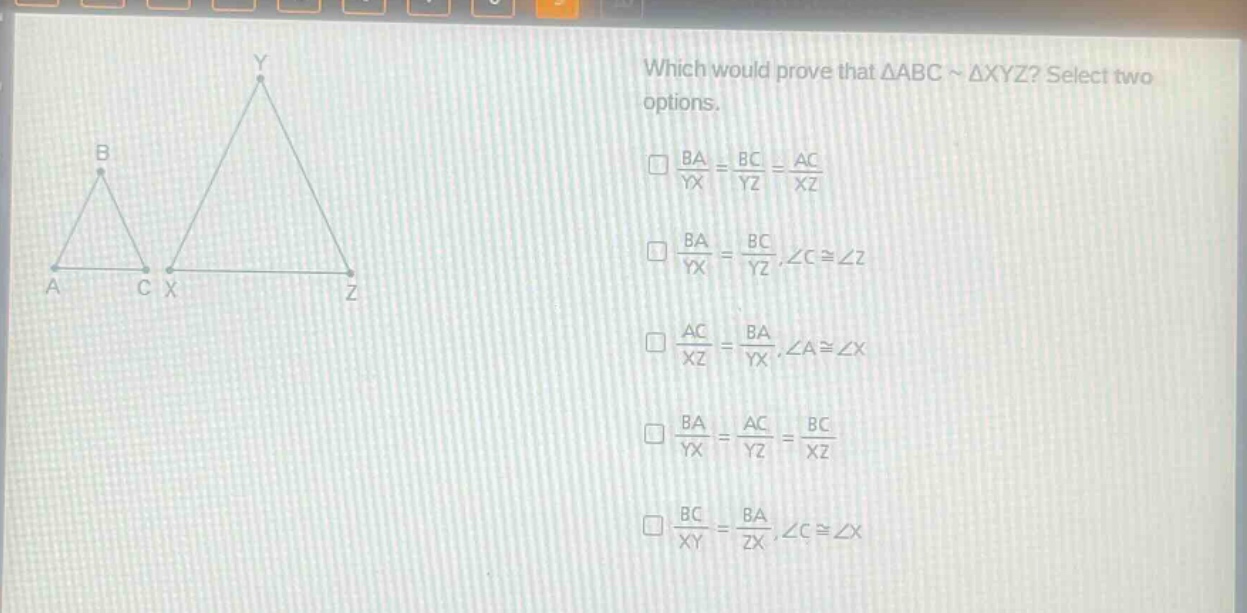
which would prove that △abc ~ △xyz? select two options.\n□\\(\\frac{ba}{yx}=\\frac{bc}{yz}=\\frac{ac}{xz}\\)\n□\\(\\frac{ba}{yx}=\\frac{bc}{yz},\\angle c\\cong\\angle z\\)\n□\\(\\frac{ac}{xz}=\\frac{ba}{yx},\\angle a\\cong\\angle x\\)\n□\\(\\frac{ba}{yx}=\\frac{ac}{yz}=\\frac{bc}{xz}\\)\n□\\(\\frac{bc}{xy}=\\frac{ba}{zx},\\angle c\\cong\\angle x\\)
Answer
Explanation:
Step1: Recall similarity - criteria
The Side - Side - Side (SSS) similarity criterion states that if the ratios of the corresponding sides of two triangles are equal, i.e., $\frac{AB}{XY}=\frac{BC}{YZ}=\frac{AC}{XZ}$, the two triangles $\triangle ABC$ and $\triangle XYZ$ are similar. Also, the Side - Angle - Side (SAS) similarity criterion states that if the ratios of two pairs of corresponding sides are equal and the included angles are congruent, the two triangles are similar.
Step2: Analyze each option
- Option 1: $\frac{BA}{YX}=\frac{BC}{YZ}=\frac{AC}{XZ}$ satisfies the SSS similarity criterion.
- Option 2: $\frac{BA}{YX}=\frac{BC}{YZ},\angle C\cong\angle Z$. Here, $\angle C$ is not the included angle between $BA$ and $BC$, and $\angle Z$ is not the included angle between $YX$ and $YZ$, so this does not satisfy the SAS criterion.
- Option 3: $\frac{AC}{XZ}=\frac{BA}{YX},\angle A\cong\angle X$. Here, the ratios of the sides and the congruent angle satisfy the SAS similarity criterion.
- Option 4: $\frac{BA}{YX}=\frac{AC}{YZ}=\frac{BC}{XZ}$ has incorrect side - pairings and does not follow the SSS or SAS criteria.
- Option 5: $\frac{BC}{XY}=\frac{BA}{ZX},\angle C\cong\angle X$ has incorrect side - pairings and does not follow the SSS or SAS criteria.
Answer:
$\frac{BA}{YX}=\frac{BC}{YZ}=\frac{AC}{XZ}$, $\frac{AC}{XZ}=\frac{BA}{YX},\angle A\cong\angle X$