a quadratic equation of the form 0 = ax² + bx + c has one real number solution. which could be the…
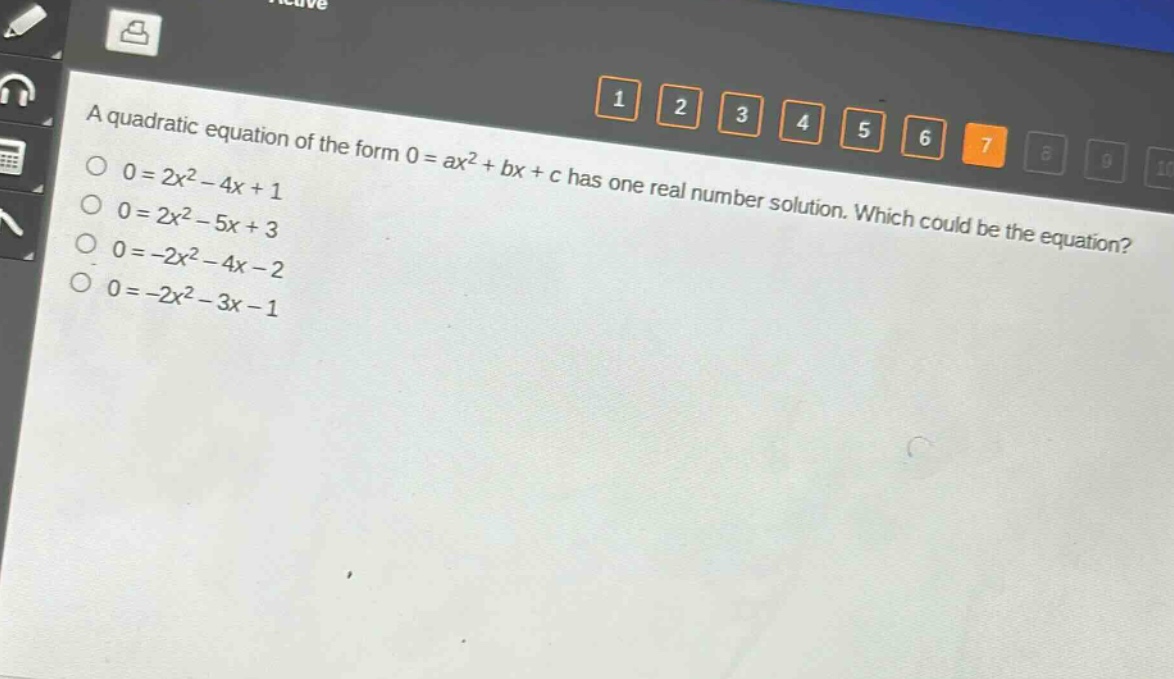
a quadratic equation of the form 0 = ax² + bx + c has one real number solution. which could be the equation?\n0 = 2x² - 4x + 1\n0 = 2x² - 5x + 3\n0 = -2x² - 4x - 2\n0 = -2x² - 3x - 1
Answer
Explanation:
Step1: Recall discriminant formula
For a quadratic equation $0 = ax^{2}+bx + c$, the discriminant $\Delta=b^{2}-4ac$. If $\Delta = 0$, the equation has one real - number solution.
Step2: Check the first equation
For $0 = 2x^{2}-4x + 1$, $a = 2$, $b=-4$, $c = 1$. Then $\Delta=(-4)^{2}-4\times2\times1=16 - 8=8\neq0$.
Step3: Check the second equation
For $0 = 2x^{2}-5x + 3$, $a = 2$, $b=-5$, $c = 3$. Then $\Delta=(-5)^{2}-4\times2\times3=25 - 24 = 1\neq0$.
Step4: Check the third equation
For $0=-2x^{2}-4x - 2$, $a=-2$, $b=-4$, $c=-2$. Then $\Delta=(-4)^{2}-4\times(-2)\times(-2)=16 - 16=0$.
Step5: Check the fourth equation
For $0=-2x^{2}-3x - 1$, $a=-2$, $b=-3$, $c=-1$. Then $\Delta=(-3)^{2}-4\times(-2)\times(-1)=9 - 8 = 1\neq0$.
Answer:
$0=-2x^{2}-4x - 2$