quadrilateral abde is a rectangle. ab = 10 cm and ae = 16 cm. through which two points could a line of…
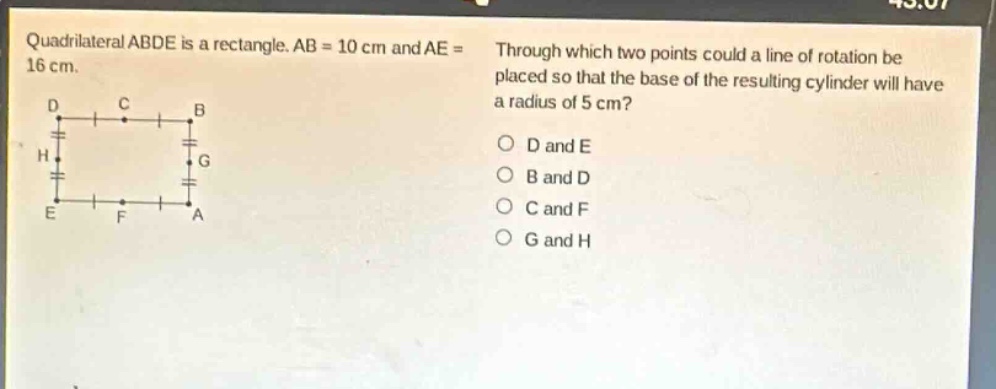
quadrilateral abde is a rectangle. ab = 10 cm and ae = 16 cm. through which two points could a line of rotation be placed so that the base of the resulting cylinder will have a radius of 5 cm? d and e b and d c and f g and h
Answer
Explanation:
Step1: Recall rectangle - cylinder relation
When a rectangle is rotated about a line to form a cylinder, the radius of the base of the cylinder is the distance from the line of rotation to the farthest - point of the rectangle from the line of rotation. Given (AB = 10) cm and (AE=16) cm. We want a radius of (r = 5) cm.
Step2: Analyze the mid - points
If we consider the mid - points of the opposite sides of the rectangle, the distance from the mid - point of one side to the opposite side is half of the length of the side it is parallel to. Since (AB = 10) cm, if we place the line of rotation through the mid - points of the sides parallel to (AB), the radius of the resulting cylinder will be (\frac{AB}{2}). The mid - points of the sides parallel to (AB) are (C) and (F). When the rectangle (ABDE) is rotated about the line passing through (C) and (F), the radius of the base of the resulting cylinder is (\frac{AB}{2}=\frac{10}{2}=5) cm.
Answer:
C. C and F