if a quadrilateral has exactly 2 lines of symmetry, and both are angle bisectors, then which statement would…
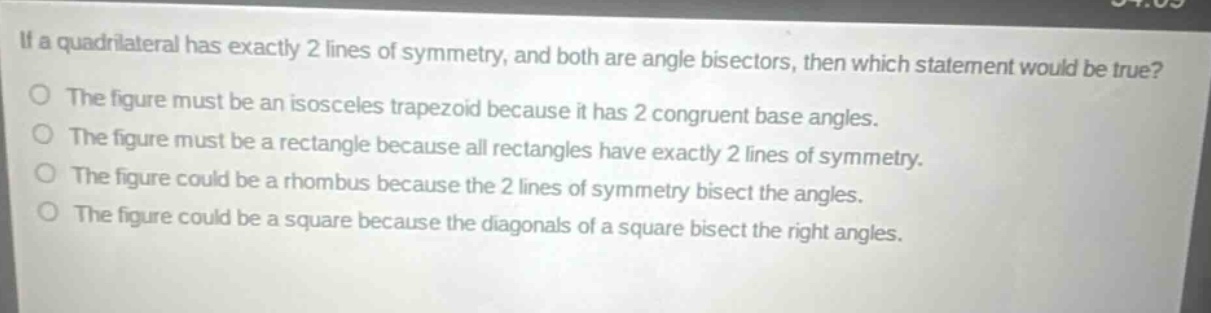
if a quadrilateral has exactly 2 lines of symmetry, and both are angle bisectors, then which statement would be true?\nthe figure must be an isosceles trapezoid because it has 2 congruent base angles.\nthe figure must be a rectangle because all rectangles have exactly 2 lines of symmetry.\nthe figure could be a rhombus because the 2 lines of symmetry bisect the angles.\nthe figure could be a square because the diagonals of a square bisect the right angles.
Answer
Brief Explanations:
- Analyze an isosceles trapezoid: An isosceles trapezoid has 1 line of symmetry, not 2 angle - bisecting lines of symmetry, so the first option is wrong.
- Analyze a rectangle: A rectangle has 2 lines of symmetry, but they are not always angle - bisectors (except for a square which is a special rectangle), so the second option is wrong.
- Analyze a rhombus: A rhombus has 2 lines of symmetry which are its diagonals, and the diagonals of a rhombus are angle - bisectors. So a quadrilateral with 2 angle - bisecting lines of symmetry could be a rhombus.
- Analyze a square: A square has 4 lines of symmetry, not 2, so the fourth option is wrong.
Answer:
The figure could be a rhombus because the 2 lines of symmetry bisect the angles.