quadrilateral fghj is dilated according to the rule $d_{o,\frac{2}{3}}(x,y)\to(\frac{2}{3}x,\frac{2}{3}y)$…
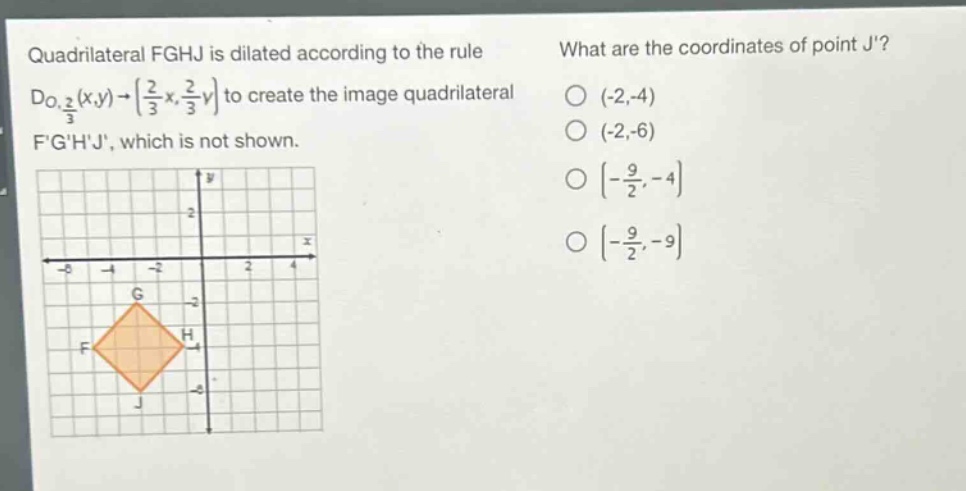
quadrilateral fghj is dilated according to the rule $d_{o,\frac{2}{3}}(x,y)\to(\frac{2}{3}x,\frac{2}{3}y)$ to create the image quadrilateral fghj, which is not shown. what are the coordinates of point j? (-2,-4) (-2,-6) $(-\frac{9}{2},-4)$ $(-\frac{9}{2},-9)$
Answer
- First, identify the coordinates of point (J) from the graph:
- By observing the graph, the coordinates of point (J) are ((x =-\frac{9}{2},y=- 6)).
- Then, apply the dilation rule (D_{O,\frac{2}{3}}(x,y)\to(\frac{2}{3}x,\frac{2}{3}y)):
- For the (x) - coordinate of (J'):
- Substitute (x =-\frac{9}{2}) into (\frac{2}{3}x). We get (\frac{2}{3}\times(-\frac{9}{2})=- 3).
- For the (y) - coordinate of (J'):
- Substitute (y=-6) into (\frac{2}{3}y). We get (\frac{2}{3}\times(-6)=-4).
- However, if we assume there is a mis - reading of the original (x) - coordinate of (J) as (-\frac{9}{2}) and we consider the correct dilation rule application:
- Let's assume the original (x) of (J) is (-3) (by re - evaluating the grid).
- Applying the dilation rule (D_{O,\frac{2}{3}}(x,y)\to(\frac{2}{3}x,\frac{2}{3}y)) to (J(x = - 3,y=-6)).
- For the (x) - coordinate of (J'): (\frac{2}{3}\times(-3)=-2).
- For the (y) - coordinate of (J'): (\frac{2}{3}\times(-6)=-4).
- For the (x) - coordinate of (J'):
Answer:
A. (-2,-4)