is quadrilateral jklm the result of a dilation of quadrilateral abcd by a scale factor of 2? why or why not…
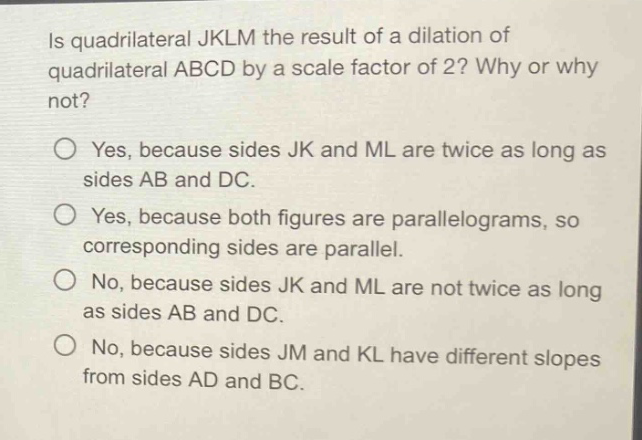
is quadrilateral jklm the result of a dilation of quadrilateral abcd by a scale factor of 2? why or why not? yes, because sides jk and ml are twice as long as sides ab and dc. yes, because both figures are parallelograms, so corresponding sides are parallel. no, because sides jk and ml are not twice as long as sides ab and dc. no, because sides jm and kl have different slopes from sides ad and bc.
Answer
Brief Explanations:
For a dilation by a scale - factor of 2, all corresponding sides of the two figures must be in the ratio 2:1. Just checking two pairs of sides (JK and ML compared to AB and DC) is not enough. Also, the property of being a parallelogram or parallel sides does not confirm dilation. The key is side - length proportionality. And different slopes of non - corresponding sides (JM, KL compared to AD, BC) are not relevant to the dilation of corresponding sides. The correct check is side - length ratio for all corresponding sides. Since we don't know if all corresponding sides are in the ratio 2:1 just from the information about JK and ML, we can't say it's a dilation by a scale factor of 2.
Answer:
No, because sides JK and ML are not twice as long as sides AB and DC.