f(4)=g(4)\nf(4)=g(-2)\nf(2)=g(-2)\nf(-2)=g(-2)
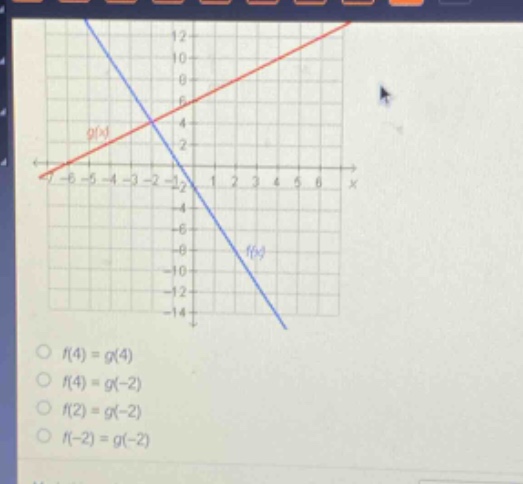
f(4)=g(4)\nf(4)=g(-2)\nf(2)=g(-2)\nf(-2)=g(-2)
Answer
Explanation:
Step1: Find the value of f(4)
Locate x = 4 on the x - axis. For the function y = f(x) (blue - line), when x = 4, y = f(4)=-14.
Step2: Find the value of g(4)
Locate x = 4 on the x - axis. For the function y = g(x) (red - line), when x = 4, y = g(4)=4. So f(4)≠g(4).
Step3: Find the value of g(-2)
Locate x=-2 on the x - axis. For the function y = g(x), when x = - 2, y = g(-2)=2.
Step4: Find the value of f(4) and check against g(-2)
We know f(4)=-14 and g(-2)=2, so f(4)≠g(-2).
Step5: Find the value of f(2)
Locate x = 2 on the x - axis. For the function y = f(x), when x = 2, y = f(2)=-8.
Step6: Check f(2) against g(-2)
Since f(2)=-8 and g(-2)=2, f(2)≠g(-2).
Step7: Find the value of f(-2)
Locate x=-2 on the x - axis. For the function y = f(x), when x=-2, y = f(-2)=2.
Step8: Check f(-2) against g(-2)
Since f(-2)=2 and g(-2)=2, f(-2)=g(-2).
Answer:
f(-2)=g(-2)