question #17\nstudy the subtraction problem with some values missing.\n8342\n-14〇7\n☆905\nwhich values can…
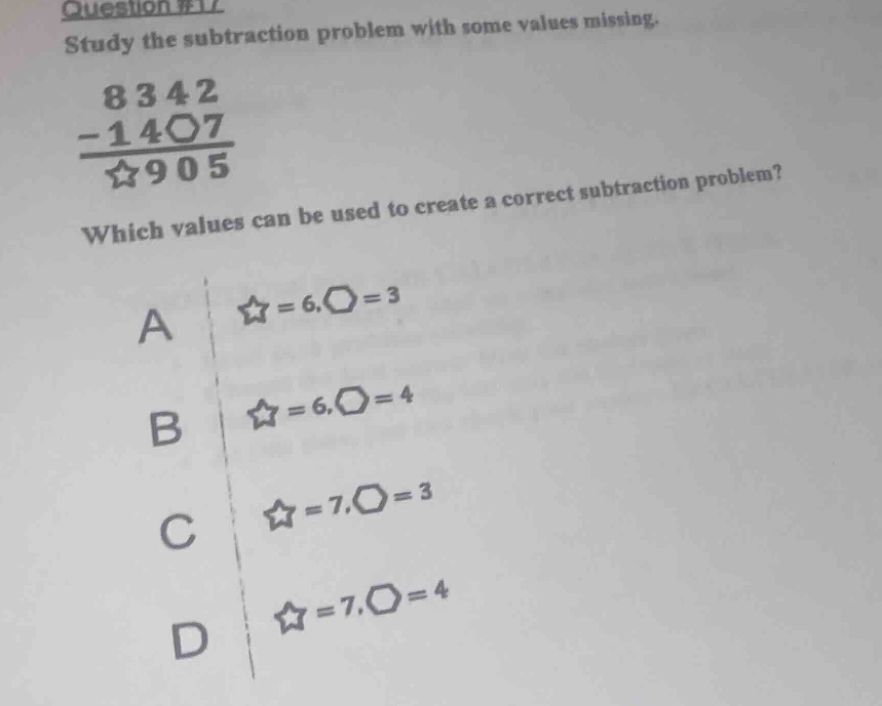
question #17\nstudy the subtraction problem with some values missing.\n8342\n-14〇7\n☆905\nwhich values can be used to create a correct subtraction problem?\na ☆ = 6,〇 = 3\nb ☆ = 6,〇 = 4\nc ☆ = 7,〇 = 3\nd ☆ = 7,〇 = 4
Answer
Explanation:
Step1: Subtract units digits
We know that (2 - 7) requires borrowing from the tens - place. After borrowing, (12-7 = 5), which is correct for the units - digit of the result.
Step2: Subtract tens digits
The tens - digit of the minuend is (4). After borrowing (1) for the units - digit subtraction, it becomes (3). We want (3-\bigcirc=0), so (\bigcirc = 3).
Step3: Subtract hundreds digits
The hundreds - digit of the minuend is (3). We subtract (4) from it. Since (3<4), we need to borrow from the thousands - place. After borrowing, (13 - 4=9), which is correct for the hundreds - digit of the result.
Step4: Subtract thousands digits
The thousands - digit of the minuend is (8). After borrowing (1) for the hundreds - digit subtraction, it becomes (7). We subtract (1) from it, (7 - 1=6), so (\star = 6).
Answer:
A. (\star = 6,\bigcirc = 3)