the quotient of $(x^{5}-3x^{3}-3x^{2}-10x + 15)$ and $(x^{2}-5)$ is a polynomial. what is the…
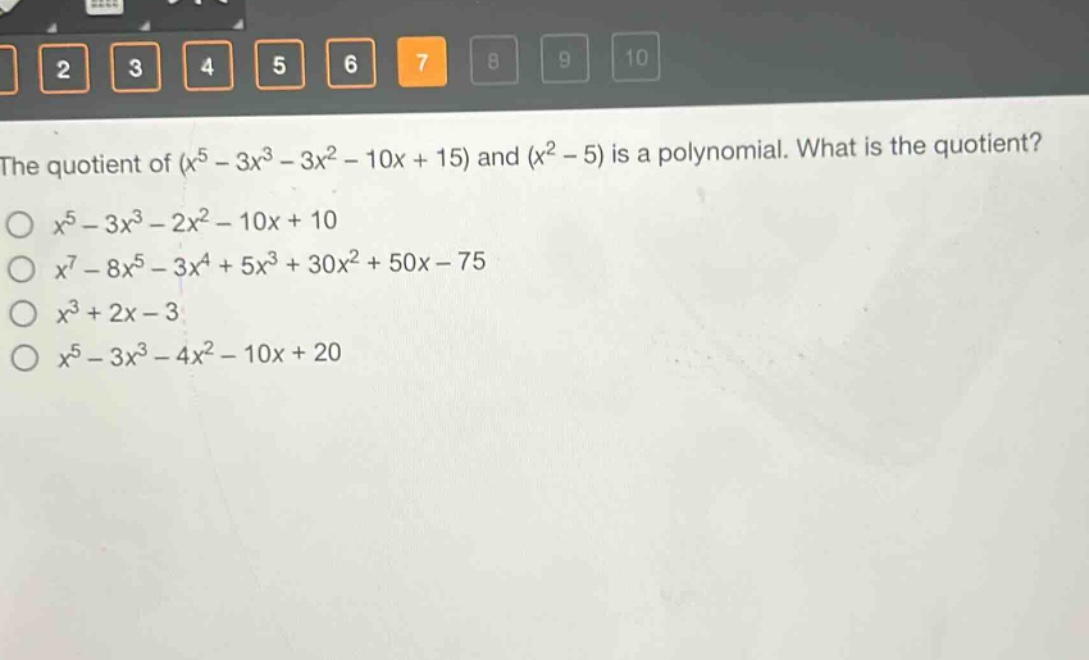
the quotient of $(x^{5}-3x^{3}-3x^{2}-10x + 15)$ and $(x^{2}-5)$ is a polynomial. what is the quotient?\n$x^{5}-3x^{3}-2x^{2}-10x + 10$\n$x^{7}-8x^{5}-3x^{4}+5x^{3}+30x^{2}+50x - 75$\n$x^{3}+2x - 3$\n$x^{5}-3x^{3}-4x^{2}-10x + 20$
Answer
Explanation:
Step1: Perform polynomial long - division
We divide (x^{5}-3x^{3}-3x^{2}-10x + 15) by (x^{2}-5). First, divide the leading term of the dividend (x^{5}) by the leading term of the divisor (x^{2}), we get (x^{3}). Multiply (x^{2}-5) by (x^{3}) to get (x^{5}-5x^{3}). Subtract this from the dividend: ((x^{5}-3x^{3}-3x^{2}-10x + 15)-(x^{5}-5x^{3})=2x^{3}-3x^{2}-10x + 15).
Step2: Continue the long - division
Divide the leading term of the new dividend (2x^{3}) by the leading term of the divisor (x^{2}), we get (2x). Multiply (x^{2}-5) by (2x) to get (2x^{3}-10x). Subtract this from the new dividend: ((2x^{3}-3x^{2}-10x + 15)-(2x^{3}-10x)=-3x^{2}+15).
Step3: Final step of long - division
Divide the leading term of the new dividend (-3x^{2}) by the leading term of the divisor (x^{2}), we get (-3). Multiply (x^{2}-5) by (-3) to get (-3x^{2}+15). Subtract this from the new dividend: ((-3x^{2}+15)-(-3x^{2}+15)=0). The quotient is (x^{3}+2x - 3).
Answer:
C. (x^{3}+2x - 3)