what is the range of $f(x)=\frac{2x^{2}-2x - 4}{x^{2}-4}$?\na. all real numbers except -2.\nb. all real…
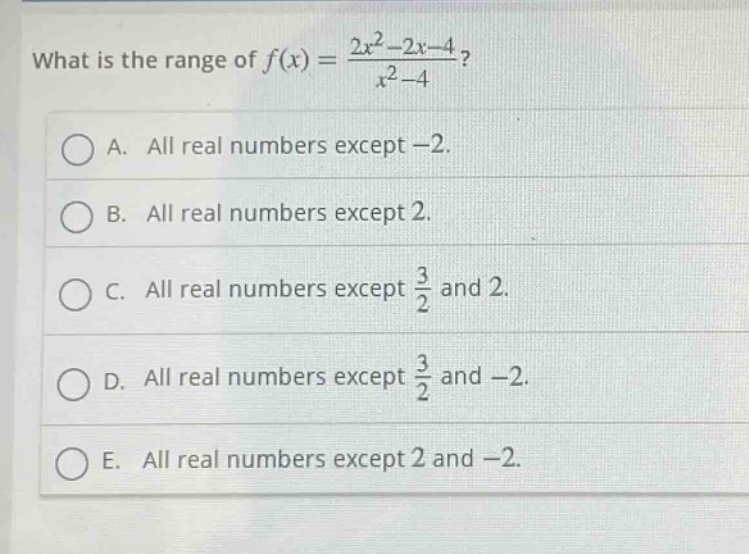
what is the range of $f(x)=\frac{2x^{2}-2x - 4}{x^{2}-4}$?\na. all real numbers except -2.\nb. all real numbers except 2.\nc. all real numbers except $\frac{3}{2}$ and 2.\nd. all real numbers except $\frac{3}{2}$ and -2.\ne. all real numbers except 2 and -2.
Answer
Explanation:
Step1: Simplify the function
First, factor the numerator and denominator. The numerator (2x^{2}-2x - 4=2(x^{2}-x - 2)=2(x - 2)(x+1)), and the denominator (x^{2}-4=(x - 2)(x + 2)). Then (y=\frac{2x^{2}-2x - 4}{x^{2}-4}=\frac{2(x - 2)(x + 1)}{(x - 2)(x + 2)}) for (x\neq2) and (x\neq - 2). Canceling out the common - factor ((x - 2)) (when (x\neq2)), we get (y=\frac{2(x + 1)}{x + 2}=2-\frac{2}{x + 2}).
Step2: Analyze the excluded values
The function (y = 2-\frac{2}{x + 2}) is undefined when (x=-2). Also, we consider the original function's domain - related exclusions. When we simplify the rational function by canceling out ((x - 2)), we need to check the value of the function at the non - removable singularity. We can find the horizontal asymptote of (y = 2-\frac{2}{x + 2}) by taking the limit as (x\to\pm\infty). (\lim_{x\to\pm\infty}(2-\frac{2}{x + 2}) = 2). To find if there are other excluded values, we set (y) equal to a value and solve for (x). Let (y=\frac{2x^{2}-2x - 4}{x^{2}-4}), then (y(x^{2}-4)=2x^{2}-2x - 4), (yx^{2}-4y=2x^{2}-2x - 4), ((y - 2)x^{2}+2x+(4 - 4y)=0). For a non - zero quadratic equation (ax^{2}+bx + c = 0) ((a=y - 2), (b = 2), (c=4 - 4y)), the discriminant (\Delta=b^{2}-4ac=4-4(y - 2)(4 - 4y)). When (y=\frac{3}{2}), (\Delta = 4-4(\frac{3}{2}-2)(4 - 4\times\frac{3}{2})=4-4\times(-\frac{1}{2})\times(-2)=4 - 4=0). This means (x) has a single value when (y=\frac{3}{2}) for the original rational function, and (y=\frac{3}{2}) is an excluded value.
Answer:
D. All real numbers except (\frac{3}{2}) and (-2)