how does the range of $g(x)=\frac{6}{x}$ compare with the range of the parent function $f(x)=\frac{1}{x}$?\nt…
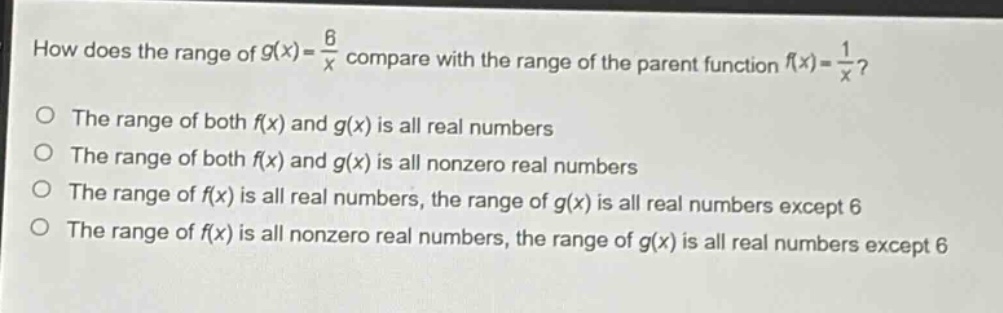
how does the range of $g(x)=\frac{6}{x}$ compare with the range of the parent function $f(x)=\frac{1}{x}$?\nthe range of both $f(x)$ and $g(x)$ is all real numbers\nthe range of both $f(x)$ and $g(x)$ is all nonzero real numbers\nthe range of $f(x)$ is all real numbers, the range of $g(x)$ is all real numbers except 6\nthe range of $f(x)$ is all nonzero real numbers, the range of $g(x)$ is all real numbers except 6
Answer
Explanation:
Step1: Recall range of parent - function
The parent function (f(x)=\frac{1}{x}) has a range of all non - zero real numbers. This is because for any non - zero real number (y), we can solve the equation (y = \frac{1}{x}) for (x=\frac{1}{y}). When (y = 0), the equation (0=\frac{1}{x}) has no solution for (x\in R).
Step2: Analyze the function (g(x)=\frac{6}{x})
For the function (g(x)=\frac{6}{x}), let (y=\frac{6}{x}). We can solve for (x=\frac{6}{y}). When (y = 0), the equation (0=\frac{6}{x}) has no solution for (x\in R). So the range of (g(x)) is also all non - zero real numbers.
Answer:
The range of both (f(x)) and (g(x)) is all nonzero real numbers