if the range of $f(x)=sqrt{mx}$ and the range of $g(x)=msqrt{x}$ are the same, which statement is true about…
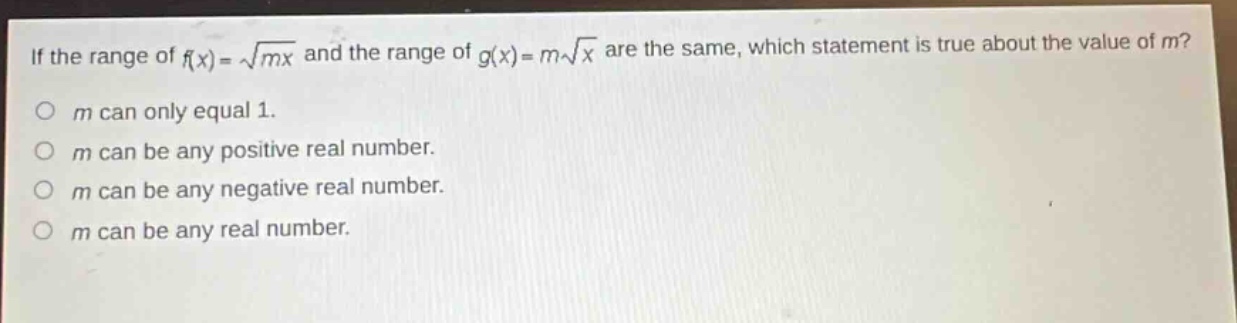
if the range of $f(x)=sqrt{mx}$ and the range of $g(x)=msqrt{x}$ are the same, which statement is true about the value of $m$?\n$m$ can only equal 1.\n$m$ can be any positive real number.\n$m$ can be any negative real number.\n$m$ can be any real number.
Answer
Explanation:
Step1: Analyze domain of (y = \sqrt{mx})
For (y=\sqrt{mx}), the expression under the square - root must be non - negative, i.e., (mx\geq0). When (m>0), the domain is (x\geq0) and (y\geq0); when (m = 0), (y = 0); when (m<0), the domain is (x\leq0) and (y\geq0).
Step2: Analyze domain of (y=m\sqrt{x})
For (y = m\sqrt{x}), the domain is (x\geq0). When (m>0), (y\geq0); when (m = 0), (y = 0); when (m<0), (y\leq0). But for the ranges to be the same, we consider non - negative cases. Since the range of (y=\sqrt{mx}) is (y\geq0) for appropriate domains, and the range of (y = m\sqrt{x}) to be the same as that of (y=\sqrt{mx}), (m) must be positive.
Answer:
B. (m) can be any positive real number.