ray ce is the angle bisector of ∠acd. which statement about the figure must be true?\n○ (mangle…
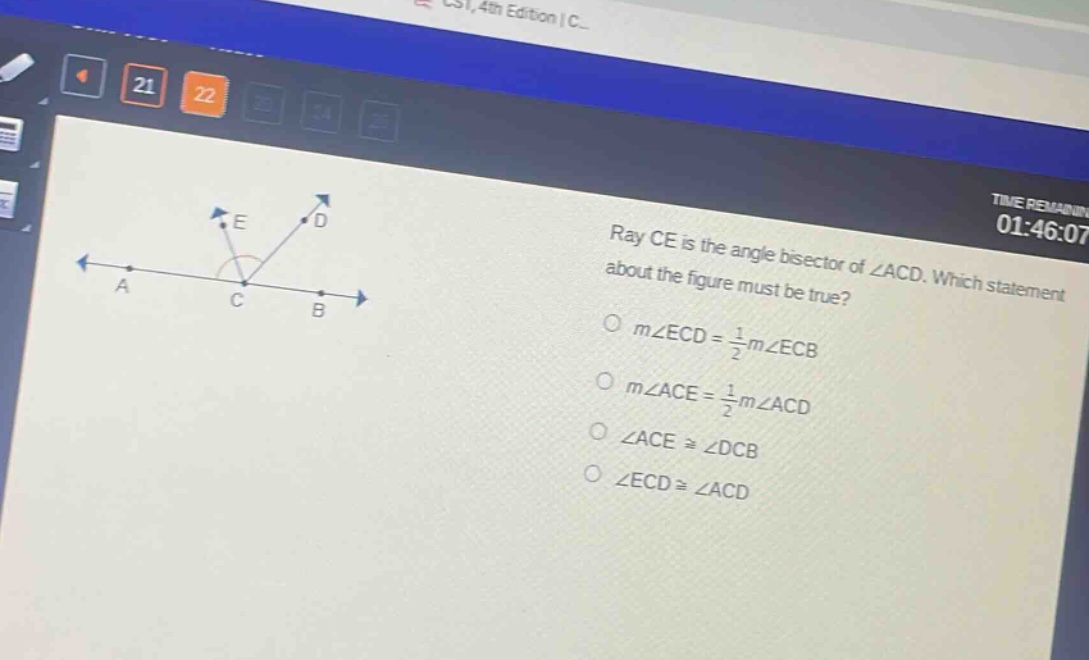
ray ce is the angle bisector of ∠acd. which statement about the figure must be true?\n○ (mangle ecd=\frac{1}{2}mangle ecb)\n○ (mangle ace=\frac{1}{2}mangle acd)\n○ (angle acecongangle dcb)\n○ (angle ecdcongangle acd)
Answer
Answer:
B. $m\angle ACE=\frac{1}{2}m\angle ACD$
Explanation:
Step1: Recall angle - bisector definition
An angle bisector divides an angle into two equal parts.
Step2: Analyze given situation
Since ray $CE$ is the angle - bisector of $\angle ACD$, by the definition of an angle bisector, $\angle ACE$ and $\angle ECD$ are the two equal parts of $\angle ACD$. So $m\angle ACE = m\angle ECD=\frac{1}{2}m\angle ACD$.
Step3: Check each option
- Option A: There is no relation to suggest $m\angle ECD=\frac{1}{2}m\angle ECB$.
- Option B: This is correct as per the angle - bisector definition.
- Option C: $\angle ACE$ and $\angle DCB$ are not necessarily equal.
- Option D: $\angle ECD$ is half of $\angle ACD$, not congruent to it.