which rays are part of line be?\n○ $overrightarrow{ac}$ and $overrightarrow{ae}$\n○ $overrightarrow{ab}$ and…
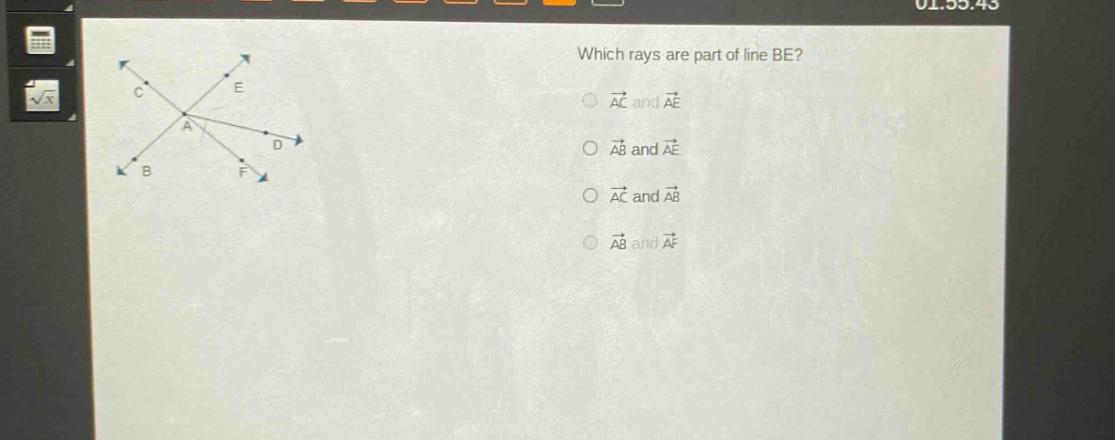
which rays are part of line be?\n○ $overrightarrow{ac}$ and $overrightarrow{ae}$\n○ $overrightarrow{ab}$ and $overrightarrow{ae}$\n○ $overrightarrow{ac}$ and $overrightarrow{ab}$\n○ $overrightarrow{ab}$ and $overrightarrow{af}$
Answer
Answer:
B. $\overrightarrow{AB}$ and $\overrightarrow{AE}$
Explanation:
Step1: Recall ray - line relationship
A line can be thought of as composed of two opposite - directed rays with a common endpoint. Line $BE$ has endpoint $A$ (assuming the intersection point is $A$). Rays that are part of line $BE$ should be on the same straight - line path as $BE$.
Step2: Analyze each option
- Option A: $\overrightarrow{AC}$ is not on the line $BE$, so this option is incorrect.
- Option B: $\overrightarrow{AB}$ and $\overrightarrow{AE}$ are on the same straight - line path as line $BE$ and share the common point $A$, so this option is correct.
- Option C: $\overrightarrow{AC}$ is not on the line $BE$, so this option is incorrect.
- Option D: $\overrightarrow{AF}$ is not on the line $BE$, so this option is incorrect.