the rectangle efgh is a dilation of the rectangle efgh. what is the scale factor of the dilation? simplify…
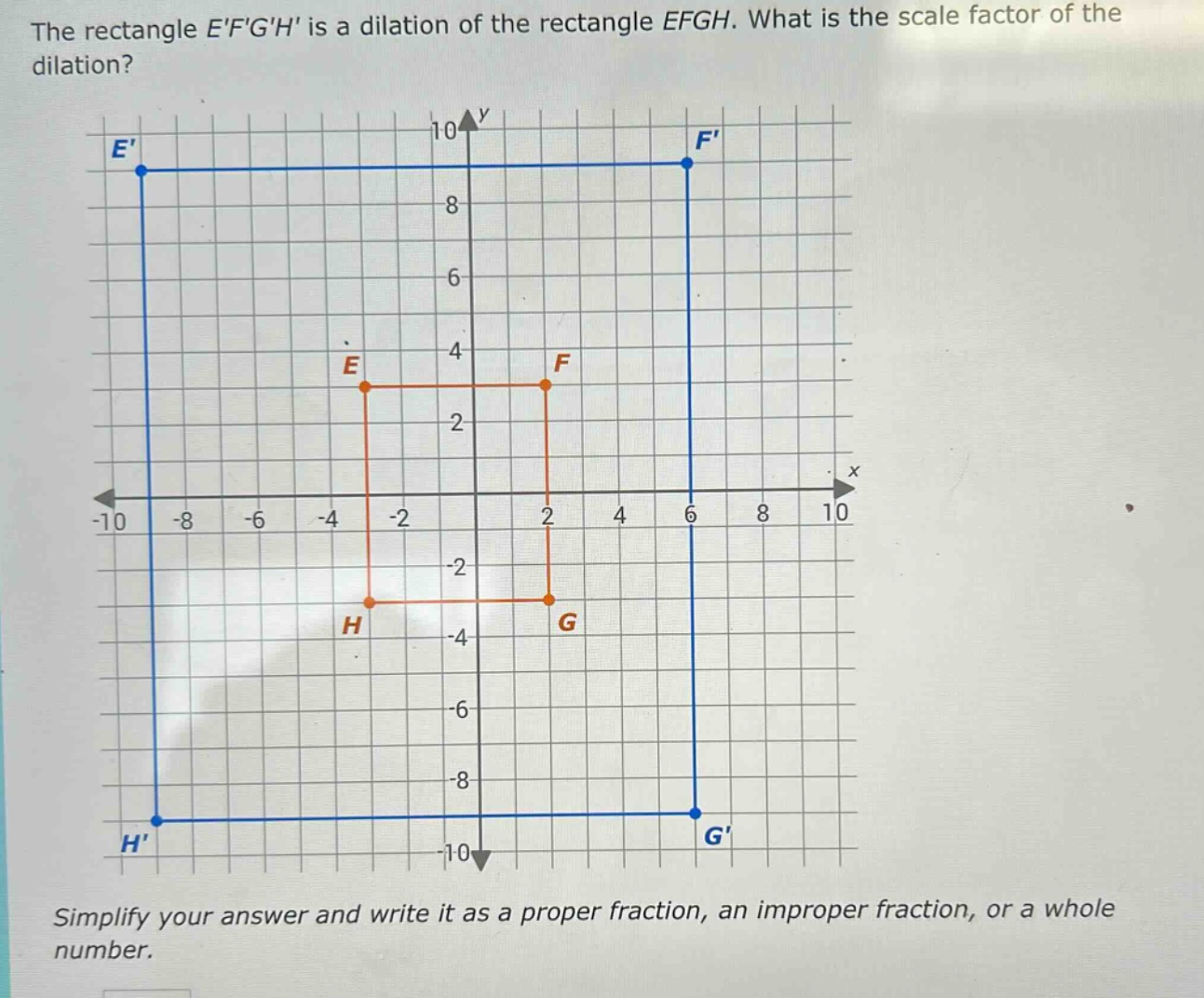
the rectangle efgh is a dilation of the rectangle efgh. what is the scale factor of the dilation? simplify your answer and write it as a proper fraction, an improper fraction, or a whole number.
Answer
Explanation:
Step1: Find side - lengths of rectangles
For rectangle (EFGH), if we consider the horizontal side (EF), the (x) - coordinates of (E(-2,3)) and (F(2,3)), the length of (EF=\vert2 - (-2)\vert = 4). For rectangle (E'F'G'H'), if we consider the horizontal side (E'F'), the (x) - coordinates of (E'(-9,9)) and (F'(6,9)), the length of (E'F'=\vert6-(-9)\vert = 15).
Step2: Calculate the scale factor
The scale factor (k) of a dilation is given by the ratio of the length of a side of the dilated figure to the length of the corresponding side of the original figure. So (k=\frac{\text{length of side in }E'F'G'H'}{\text{length of corresponding side in }EFGH}). Using the horizontal sides, (k = \frac{15}{4}).
Answer:
(\frac{15}{4})