is rectangle efgh the result of a dilation of rectangle abcd with a center of dilation at the origin? why or…
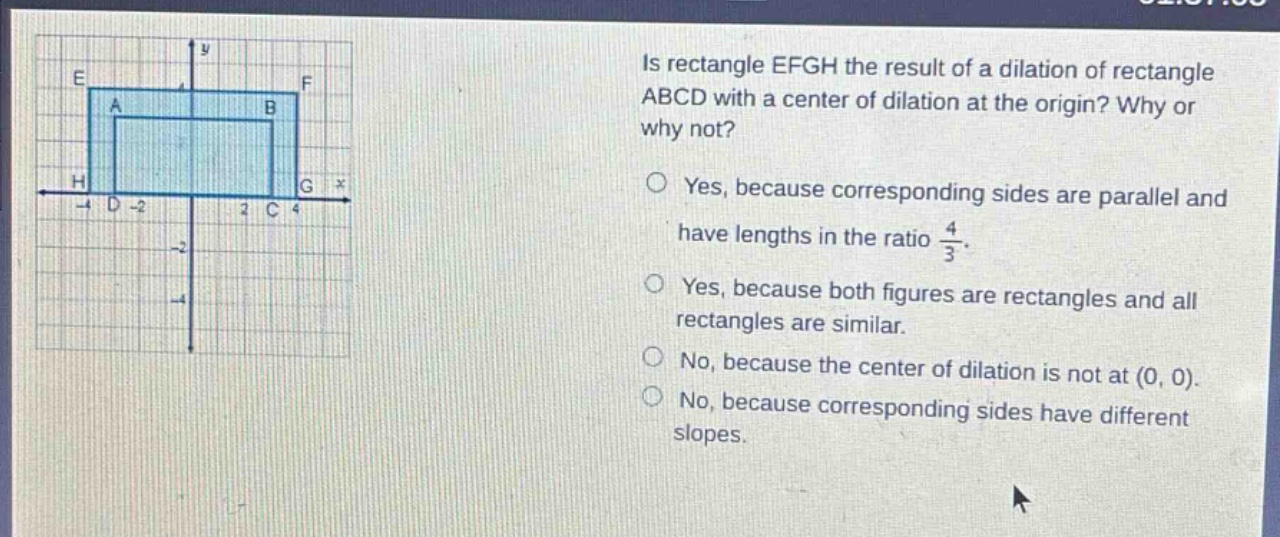
is rectangle efgh the result of a dilation of rectangle abcd with a center of dilation at the origin? why or why not? yes, because corresponding sides are parallel and have lengths in the ratio $\frac{4}{3}$. yes, because both figures are rectangles and all rectangles are similar. no, because the center of dilation is not at (0, 0). no, because corresponding sides have different slopes.
Answer
Answer:
A. Yes, because corresponding sides are parallel and have lengths in the ratio $\frac{4}{3}$.
Explanation:
Step1: Recall dilation properties
In dilation from origin, corresponding - sides of pre - image and image are parallel and the ratio of their lengths is the scale factor.
Step2: Analyze option A
If corresponding sides are parallel and have a constant ratio of lengths, it is a dilation. This option satisfies the properties of dilation from the origin.
Step3: Analyze option B
Just because two figures are rectangles does not mean one is a dilation of the other. Similarity is not enough to confirm dilation from a specific center (the origin here).
Step4: Analyze option C
The center of dilation is stated to be at the origin in the problem, so this option is incorrect.
Step5: Analyze option D
In a dilation from the origin, corresponding sides should be parallel (have the same slopes), not different slopes. So this option is incorrect.