a rectangle has a length that is 5 inches greater than its width, and its area is 104 square inches. the…
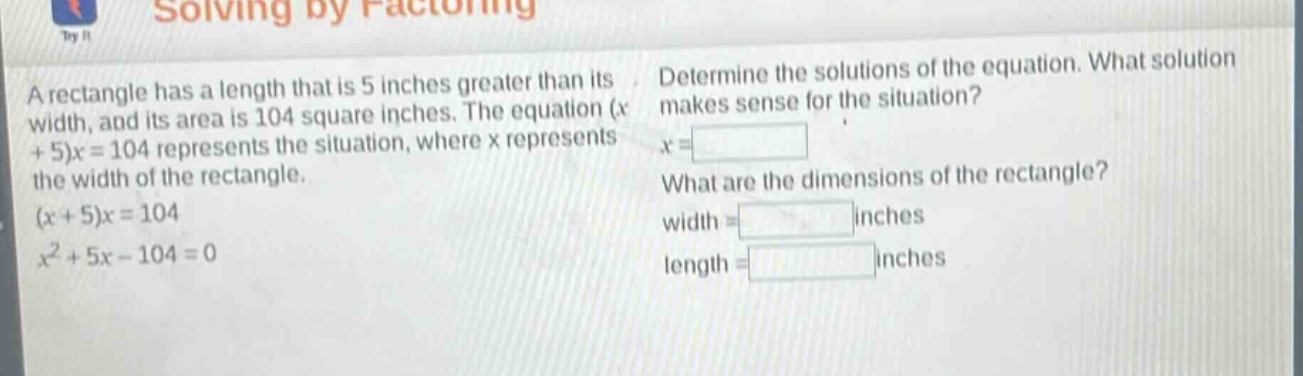
a rectangle has a length that is 5 inches greater than its width, and its area is 104 square inches. the equation (x + 5)x = 104 represents the situation, where x represents the width of the rectangle. (x + 5)x = 104 x² + 5x - 104 = 0 determine the solutions of the equation. what solution makes sense for the situation? x = what are the dimensions of the rectangle? width = inches length = inches
Answer
Explanation:
Step1: Factor the quadratic equation
We have the quadratic equation (x^{2}+5x - 104=0). We need to find two numbers that multiply to (- 104) and add up to (5). The numbers are (13) and (-8) since (13\times(-8)=-104) and (13+( - 8)=5). So, the factored form is ((x + 13)(x - 8)=0).
Step2: Solve for (x)
Using the zero - product property, if ((x + 13)(x - 8)=0), then (x+13 = 0) or (x - 8=0). Solving (x+13 = 0) gives (x=-13), and solving (x - 8=0) gives (x = 8).
Step3: Select the valid solution
Since (x) represents the width of a rectangle and width cannot be negative, the valid solution for (x) is (x = 8).
Step4: Find the length and width
The width of the rectangle is (x), so the width is (8) inches. The length is (x + 5), so the length is (8+5=13) inches.
Answer:
(x = 8) width = (8) inches length = (13) inches