a rectangle is transformed according to the rule $r_{0,90^{circ}}$. the image of the rectangle has vertices…
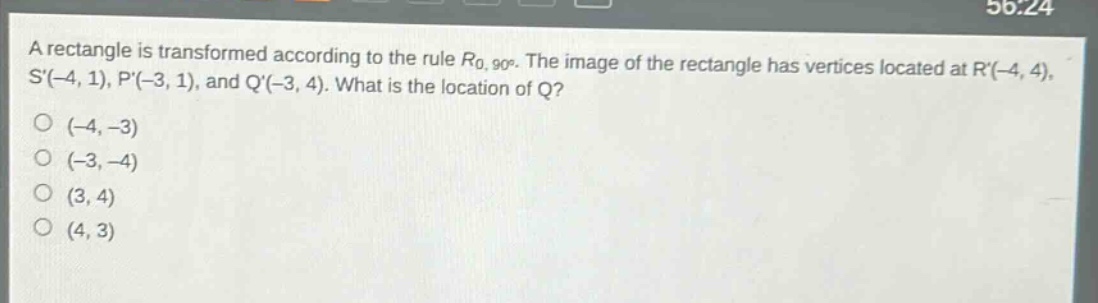
a rectangle is transformed according to the rule $r_{0,90^{circ}}$. the image of the rectangle has vertices located at $r(-4,4)$, $s(-4,1)$, $p(-3,1)$, and $q(-3,4)$. what is the location of $q$?\n(-4,-3)\n(-3,-4)\n(3,4)\n(4,3)
Answer
Explanation:
Step1: Recall rotation rule
The rule $R_{0,90^{\circ}}$ for rotating a point $(x,y)$ counter - clockwise about the origin by $90^{\circ}$ is $(x,y)\to(-y,x)$.
Step2: Analyze rectangle properties
In a rectangle, opposite sides are parallel and equal. Given the vertices $R'(-4,4)$, $S'(-4,1)$, $P'(-3,1)$, and $Q'$. Since $R'$ and $S'$ have the same $x$ - coordinate, and $P'$ and $Q'$ should have the same $x$ - coordinate as $R'$ and $S'$ respectively for the rectangle's side - length relationships. Also, since $S'$ and $P'$ have the same $y$ - coordinate, we know that to find the pre - image of $Q'$ (the original point $Q$ before rotation), we reverse the rotation rule. The reverse of $(x,y)\to(-y,x)$ is $(x,y)\to(y, - x)$.
Step3: Determine the pre - image of $Q'$
The coordinates of $Q'$ are $(-3,4)$. Applying the reverse rotation rule $(x,y)\to(y, - x)$ to $Q'(-3,4)$, we get $(4,3)$.
Answer:
$(4,3)$