representing a sequence with an explicit function\nthe first five terms of an arithmetic sequence are shown…
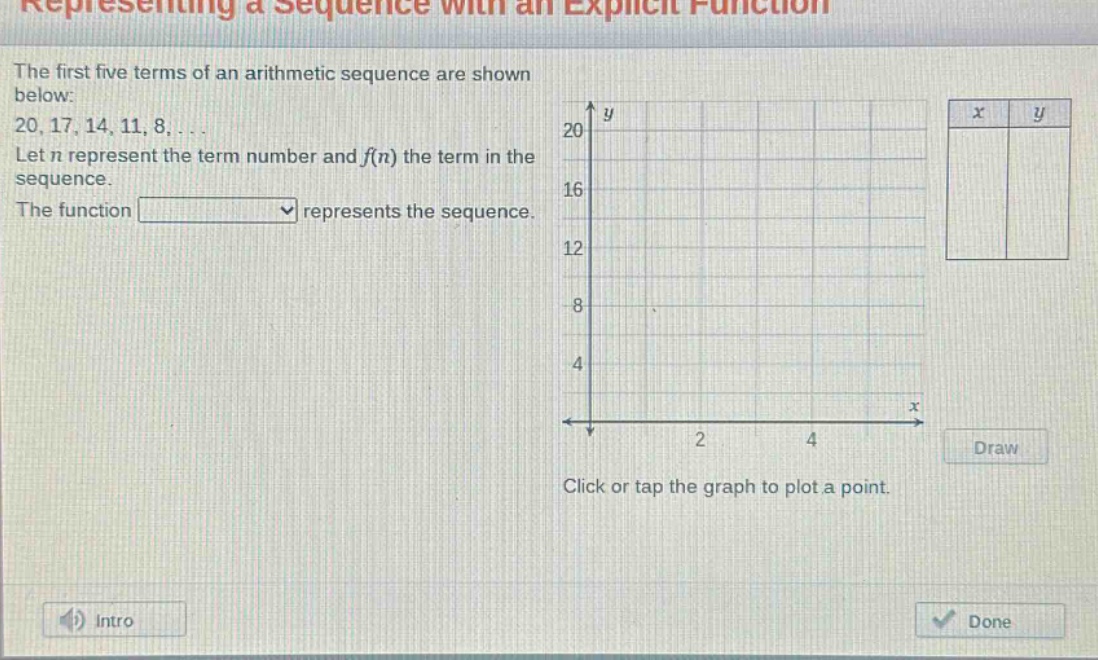
representing a sequence with an explicit function\nthe first five terms of an arithmetic sequence are shown below:\n20, 17, 14, 11, 8, ...\nlet n represent the term number and f(n) the term in the sequence.\nthe function represents the sequence.
Answer
Answer:
$f(n)=23 - 3n$
Explanation:
Step1: Identify the first - term and common difference
The first term $a_1 = 20$. The common difference $d=17 - 20=- 3$.
Step2: Use the formula for the $n$th term of an arithmetic sequence
The formula for the $n$th term of an arithmetic sequence is $a_n=a_1+(n - 1)d$. Substitute $a_1 = 20$ and $d=-3$ into the formula: $a_n=20+(n - 1)(-3)$.
Step3: Simplify the formula
Expand the expression: $a_n=20-3n + 3$. Combine like - terms: $a_n=23 - 3n$. So $f(n)=23 - 3n$.