which represents a function?\n| x | y |\n| -5 | 10 |\n| -3 | 5 |\n| -3 | 4 |\n| 0 | 0 |\n| 5 | -10 |\n{(-8…
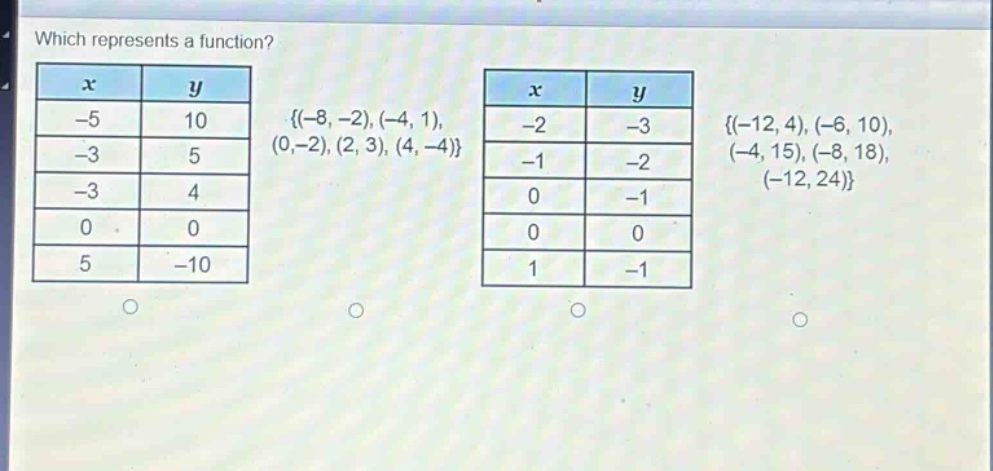
which represents a function?\n| x | y |\n| -5 | 10 |\n| -3 | 5 |\n| -3 | 4 |\n| 0 | 0 |\n| 5 | -10 |\n{(-8, -2), (-4, 1), (0, -2), (2, 3), (4, -4)}\n| x | y |\n| -2 | -3 |\n| -1 | -2 |\n| 0 | -1 |\n| 0 | 0 |\n| 1 | -1 |\n{(-12, 4), (-6, 10), (-4, 15), (-8, 18), (-12, 24)}
Answer
Answer:
The set of ordered - pairs ({(-8,-2),(-4,1),(0, - 2),(2,3),(4,-4)}) and the table with (x) values (-2,-1,0,0,1) and (y) values (-3,-2,-1,0,-1) (the second table) represent functions.
Explanation:
Step1: Recall function definition
A function is a relation where each input ((x) - value) has exactly one output ((y) - value).
Step2: Analyze first table
In the first table, when (x=-3), (y = 5) and (y = 4). Since the input (x=-3) has two different outputs, it is not a function.
Step3: Analyze first set of ordered - pairs
For the set ({(-8,-2),(-4,1),(0, - 2),(2,3),(4,-4)}), each (x) - value (-8,-4,0,2,4) has a unique (y) - value. So it is a function.
Step4: Analyze second table
In the second table, although (x = 0) appears twice, it has the same (y) - value ((y=-1) and (y = 0) for different rows is not a violation as long as for each distinct (x) there is a single (y)). Each distinct (x) has a single (y) - value, so it is a function.
Step5: Analyze second set of ordered - pairs
In the set ({(-12,4),(-6,10),(-4,15),(-8,18),(-12,24)}), the input (x=-12) has two different outputs ((y = 4) and (y = 24)), so it is not a function.