which will result in a perfect square trinomial?\n(3x - 5)(3x - 5)\n(3x - 5)(5 - 3x)\n(3x - 5)(3x + 5)\n(3x…
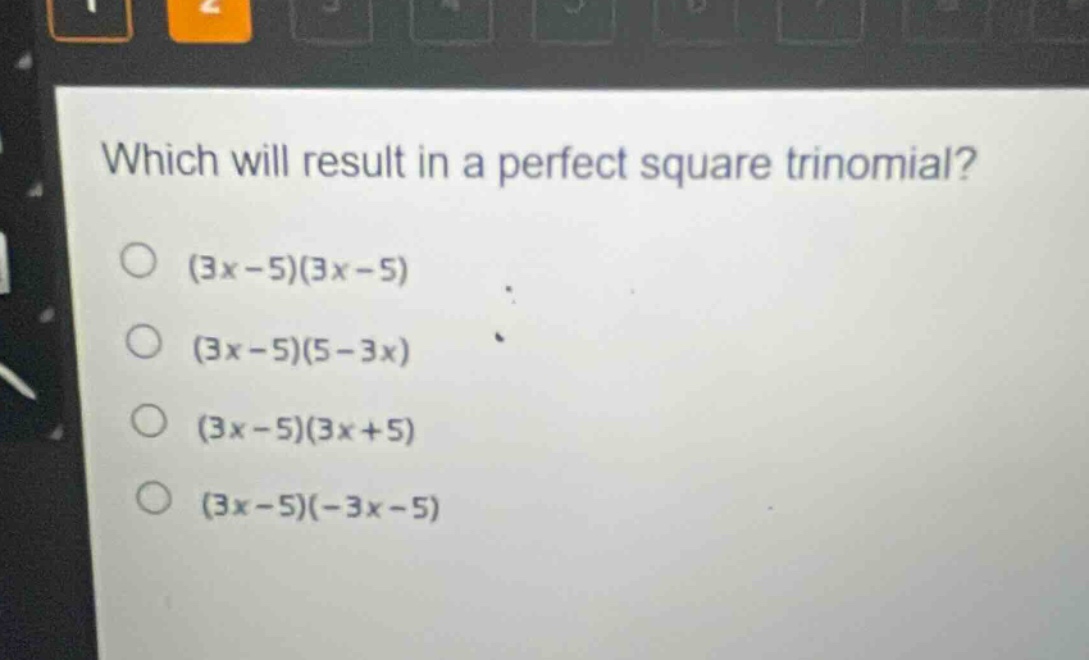
which will result in a perfect square trinomial?\n(3x - 5)(3x - 5)\n(3x - 5)(5 - 3x)\n(3x - 5)(3x + 5)\n(3x - 5)(-3x - 5)
Answer
Explanation:
Step1: Recall perfect - square trinomial formula
The formula for a perfect - square trinomial is ((a\pm b)^2=a^{2}\pm2ab + b^{2}), which is equivalent to ((a + b)(a + b)) or ((a - b)(a - b)).
Step2: Analyze each option
- Option 1: ((3x - 5)(3x - 5)=(3x-5)^{2}). Using the formula ((a - b)^2=a^{2}-2ab + b^{2}), where (a = 3x) and (b = 5), we get ((3x)^{2}-2\times(3x)\times5+5^{2}=9x^{2}-30x + 25), which is a perfect - square trinomial.
- Option 2: ((3x - 5)(5 - 3x)=-(3x - 5)(3x - 5)=-(3x - 5)^{2}=-9x^{2}+30x - 25), not a perfect - square trinomial in the standard form.
- Option 3: ((3x - 5)(3x + 5)=(3x)^{2}-5^{2}=9x^{2}-25) (using the difference - of - squares formula ((a + b)(a - b)=a^{2}-b^{2})), not a trinomial.
- Option 4: ((3x - 5)(-3x - 5)=-(3x - 5)(3x + 5)=-(9x^{2}-25)=-9x^{2}+25), not a trinomial.
Answer:
((3x - 5)(3x - 5))