review the graphs of complex numbers z and w.\nwhat is $\frac{z}{w}$?\n$\boldsymbol{-4 + 16i}$\n$\boldsymbol{…
review the graphs of complex numbers z and w.\nwhat is $\frac{z}{w}$?\n$\boldsymbol{-4 + 16i}$\n$\boldsymbol{6 + 10i}$\n$\boldsymbol{7 + 11i}$\n$\boldsymbol{8 + 2i}$
Answer
Explanation:
Step1: Identify complex numbers
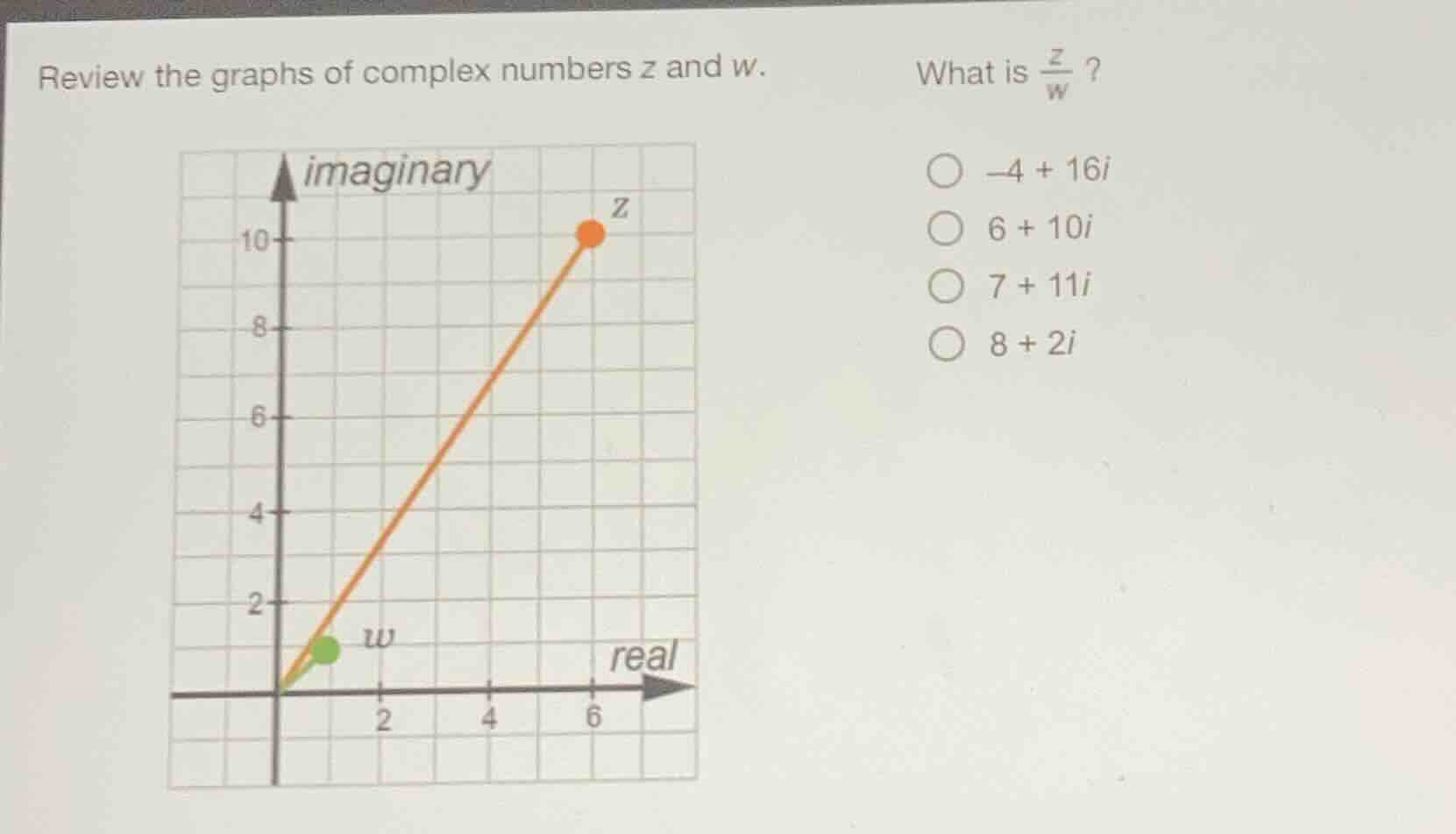
From the graph: $z = 6 + 10i$, $w = 1 + i$
Step2: Multiply by conjugate of $w$
Multiply numerator and denominator by $1-i$: $\frac{z}{w} = \frac{(6+10i)(1-i)}{(1+i)(1-i)}$
Step3: Expand numerator
Use FOIL method: $(6+10i)(1-i) = 6(1) + 6(-i) + 10i(1) + 10i(-i) = 6 -6i +10i -10i^2$ Since $i^2=-1$, this becomes $6 +4i +10 = 16 +4i$
Step4: Expand denominator
Difference of squares: $(1+i)(1-i) = 1^2 - i^2 = 1 - (-1) = 2$
Step5: Simplify the fraction
Divide numerator by denominator: $\frac{16+4i}{2} = 8 + 2i$
Answer:
8 + 2i