right angle fcd intersects $overleftrightarrow{ab}$ and $overleftrightarrow{ce}$ at point c. $angle$ fce is…
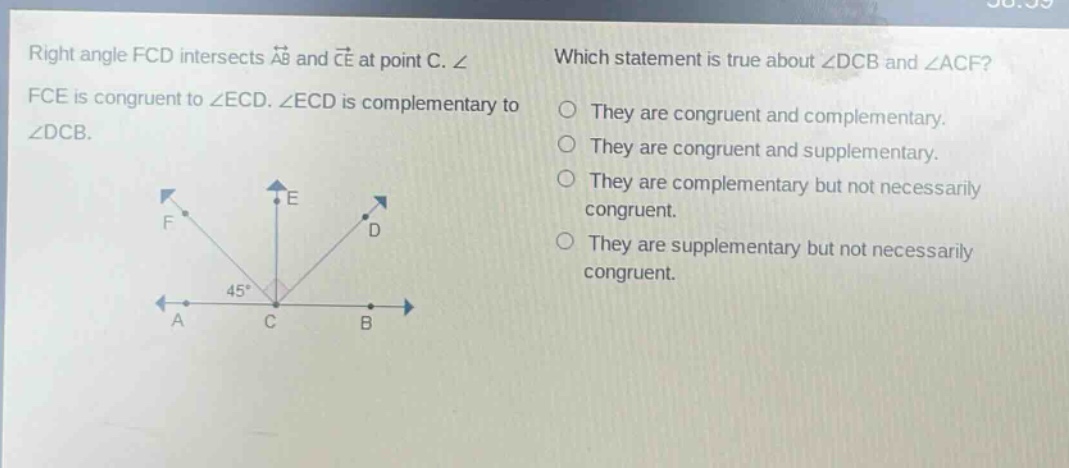
right angle fcd intersects $overleftrightarrow{ab}$ and $overleftrightarrow{ce}$ at point c. $angle$ fce is congruent to $angle$ ecd. $angle$ ecd is complementary to $angle$ dcb. which statement is true about $angle$ dcb and $angle$ acf? they are congruent and complementary. they are congruent and supplementary. they are complementary but not necessarily congruent. they are supplementary but not necessarily congruent.
Answer
Answer:
They are congruent and complementary.
Explanation:
Step1: Analyze given angle - relationships
Since $\angle FCD = 90^{\circ}$ and $\angle FCE\cong\angle ECD$, then $\angle FCE=\angle ECD = 45^{\circ}$.
Step2: Find $\angle DCB$
$\angle ECD$ is complementary to $\angle DCB$, so $\angle ECD+\angle DCB = 90^{\circ}$. Since $\angle ECD = 45^{\circ}$, then $\angle DCB=45^{\circ}$.
Step3: Find $\angle ACF$
$\angle ACF = 45^{\circ}$ (from the given figure or by the fact that $\angle FCD = 90^{\circ}$ and the symmetry - like situation).
Step4: Determine the relationship between $\angle DCB$ and $\angle ACF$
Since $\angle DCB = 45^{\circ}$ and $\angle ACF = 45^{\circ}$, they are congruent. Also, $\angle DCB+\angle ACF=45^{\circ}+45^{\circ}=90^{\circ}$, so they are complementary.