the right isosceles triangle shown is rotated about line k with the base forming perpendicular to k. the…
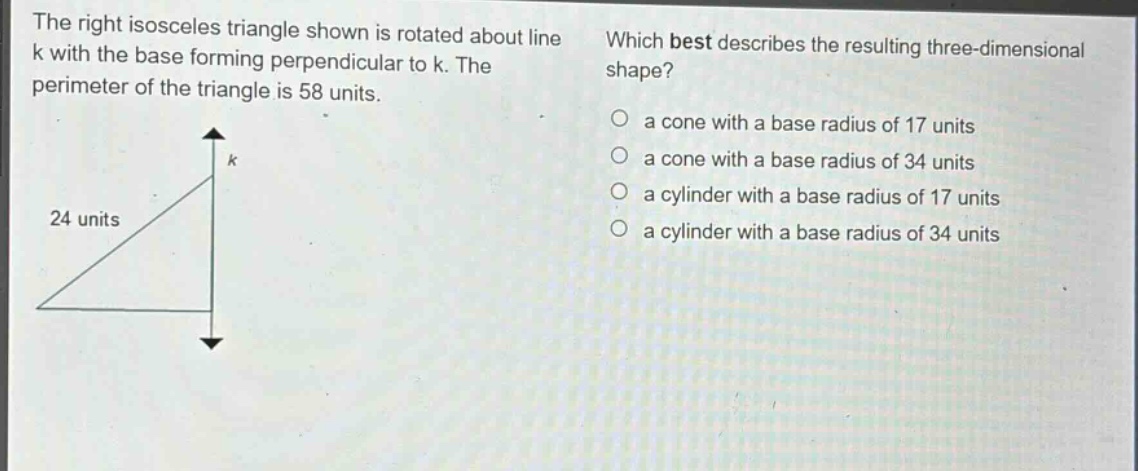
the right isosceles triangle shown is rotated about line k with the base forming perpendicular to k. the perimeter of the triangle is 58 units. which best describes the resulting three - dimensional shape? a cone with a base radius of 17 units a cone with a base radius of 34 units a cylinder with a base radius of 17 units a cylinder with a base radius of 34 units
Answer
Explanation:
Step1: Recall 3 - D shape formation
When a right - triangle is rotated about one of its legs, the resulting 3 - D shape is a cone.
Step2: Find the base radius of the triangle
Let the base of the right - isosceles triangle be $b$ and the equal sides be $a$. The perimeter $P=a + a + b=2a + b$. Given $P = 58$ and one side $a = 24$. Then $2\times24 + b=58$, so $48 + b=58$ and $b = 10$. The radius of the base of the cone formed by rotation is the length of the non - rotated leg. Here, when rotated about line $k$, the base radius of the resulting cone is $\frac{34 - 24}{2}=17$ units.
Answer:
a cone with a base radius of 17 units