if -1 is a root of f(x), which of the following must be true?\na factor of f(x) is (x - 1).\na factor of…
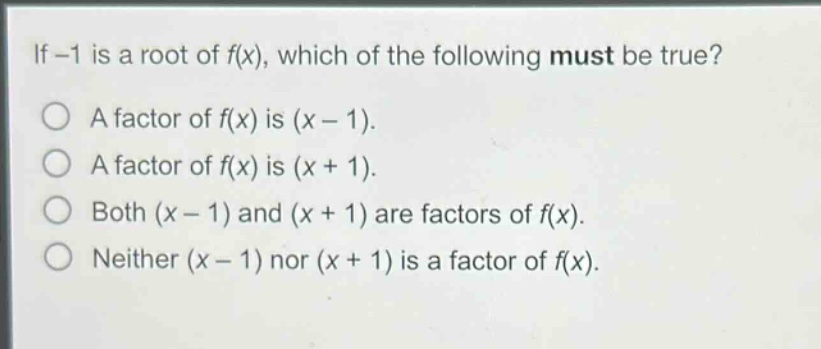
if -1 is a root of f(x), which of the following must be true?\na factor of f(x) is (x - 1).\na factor of f(x) is (x + 1).\nboth (x - 1) and (x + 1) are factors of f(x).\nneither (x - 1) nor (x + 1) is a factor of f(x).
Answer
Explanation:
Step1: Recall factor - root relationship
If (r) is a root of a polynomial (f(x)), then ((x - r)) is a factor of (f(x)).
Step2: Identify the root value
Given that (r=-1) is a root of (f(x)).
Step3: Determine the factor
Substitute (r = - 1) into ((x - r)), we get ((x-(-1))=(x + 1)). So ((x + 1)) is a factor of (f(x)).
Answer:
A factor of (f(x)) is ((x + 1)).