which rule explains why these scalene triangles are similar?\nsss\nsas\naa\nnone of the above; the triangles…
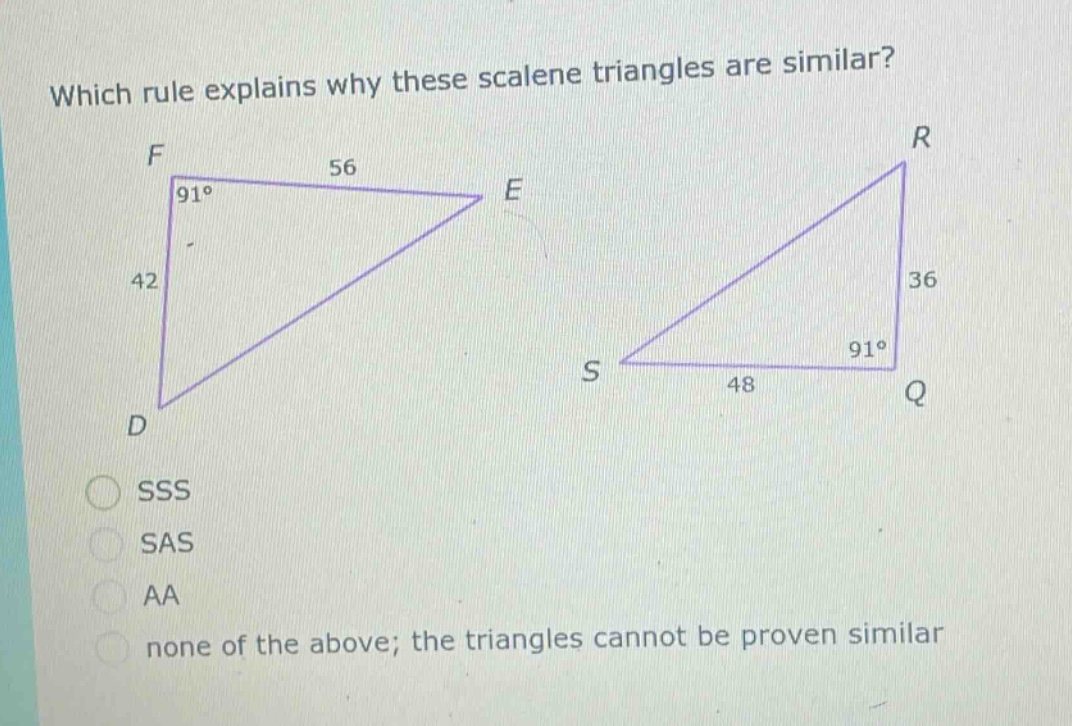
which rule explains why these scalene triangles are similar?\nsss\nsas\naa\nnone of the above; the triangles cannot be proven similar
Answer
Explanation:
Step1: Identify corresponding angles and sides.
In $\triangle DEF$, we have $\angle F = 91^\circ$, $DF = 42$, $FE = 56$. In $\triangle RQS$, we have $\angle Q = 91^\circ$, $RQ = 36$, $QS = 48$. The angles $\angle F$ and $\angle Q$ are the included angles between the given sides.
Step2: Check if the included angles are equal.
We are given $\angle F = 91^\circ$ and $\angle Q = 91^\circ$. So, $\angle F = \angle Q$.
Step3: Check if the ratios of corresponding sides are equal.
We compare the ratios of the sides that form the equal angles. Let's check the ratio $\frac{DF}{RQ}$ and $\frac{FE}{QS}$. $$ \frac{DF}{RQ} = \frac{42}{36} $$ $$ \frac{FE}{QS} = \frac{56}{48} $$
Step4: Simplify the ratios.
Simplify the first ratio: $$ \frac{42}{36} = \frac{6 \times 7}{6 \times 6} = \frac{7}{6} $$ Simplify the second ratio: $$ \frac{56}{48} = \frac{8 \times 7}{8 \times 6} = \frac{7}{6} $$
Step5: Conclude based on similarity rules.
Since the ratios of the corresponding sides are equal ($\frac{DF}{RQ} = \frac{FE}{QS} = \frac{7}{6}$) and the included angles are equal ($\angle F = \angle Q$), the triangles are similar by the SAS (Side-Angle-Side) similarity rule.
Answer:
SAS