what is the rule for the reflection?\n$r_{y = x}(x,y)\to(-y,-x)$\n$r_{y=-x}(x,y)\to(-y,-x)$\n$r_{y =…
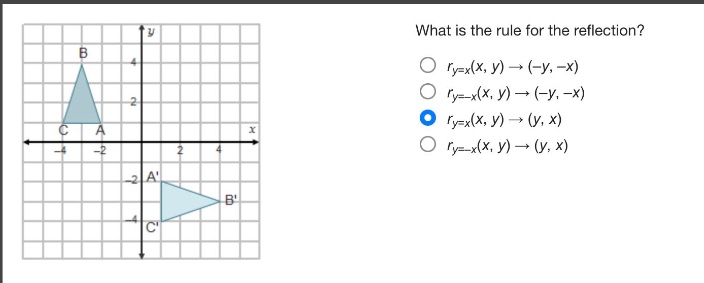
what is the rule for the reflection?\n$r_{y = x}(x,y)\to(-y,-x)$\n$r_{y=-x}(x,y)\to(-y,-x)$\n$r_{y = x}(x,y)\to(y,x)$\n$r_{y=-x}(x,y)\to(y,x)$
Answer
Explanation:
Step1: Recall reflection rules
When reflecting a point $(x,y)$ over the line $y = x$, the $x$ - and $y$ - coordinates are swapped. That is, the rule is $(x,y)\to(y,x)$. When reflecting over the line $y=-x$, the rule is $(x,y)\to(-y, -x)$.
Step2: Analyze the graph
We can see that the triangle $\triangle ABC$ is reflected over the line $y = x$ to get $\triangle A'B'C'$. For example, if we consider a point on $\triangle ABC$ say $(x,y)$ and its corresponding point on $\triangle A'B'C'$, the coordinates are swapped.
Answer:
$r_{y = x}(x,y)\to(y,x)$