sam is building a square patio out of paving stones for a customer. the customer chose square paving stones…
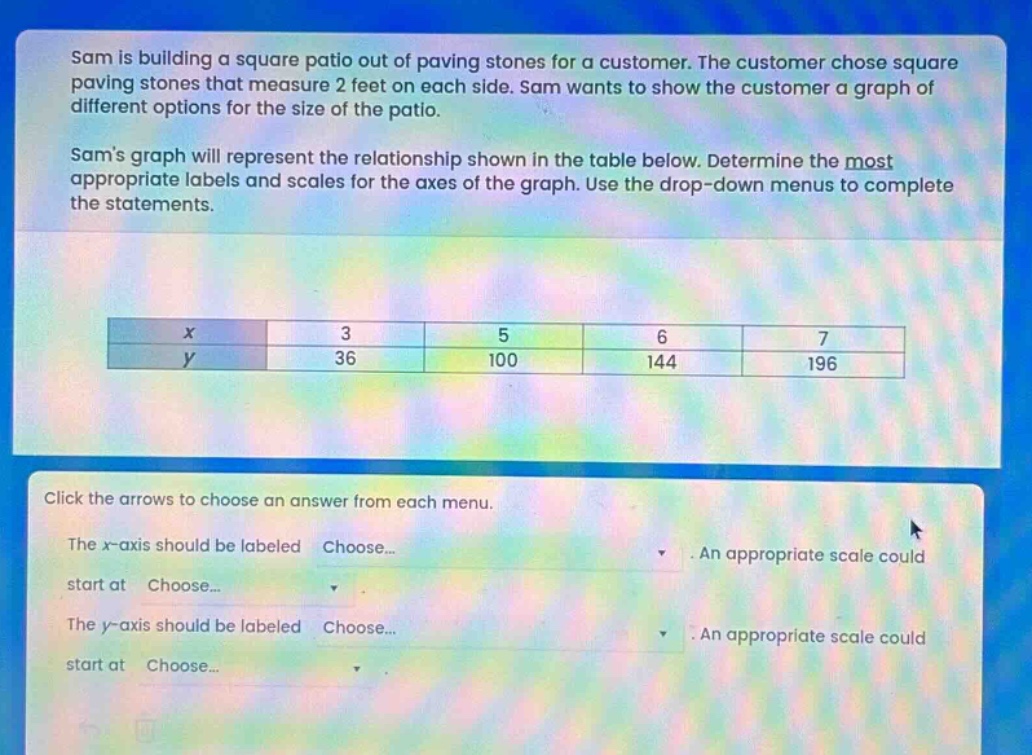
sam is building a square patio out of paving stones for a customer. the customer chose square paving stones that measure 2 feet on each side. sam wants to show the customer a graph of different options for the size of the patio. sams graph will represent the relationship shown in the table below. determine the most appropriate labels and scales for the axes of the graph. use the drop - down menus to complete the statements.\n\n| x | 3 | 5 | 6 | 7 |\n| y | 36 | 100 | 144 | 196 |\n\nclick the arrows to choose an answer from each menu.\nthe x - axis should be labeled choose... . an appropriate scale could start at choose... .\nthe y - axis should be labeled choose... . an appropriate scale could start at choose... .
Answer
Explanation:
Step1: Analyze the data
The (x) - values likely represent the number of paving - stones along one side of the square patio. The (y) - values are the areas of the patios. Since each paving stone is 2 feet on each side, the area of one paving stone is (2\times2 = 4) square feet. And (y=(2x)^2 = 4x^{2}).
Step2: Determine (x) - axis label
The (x) - axis represents the number of paving stones along one side of the square patio. So, it should be labeled "Number of Paving Stones Along One Side".
Step3: Determine (x) - axis scale
The smallest (x) value in the table is 3. An appropriate scale for the (x) - axis could start at 0 to include all possible non - negative values of the number of paving stones.
Step4: Determine (y) - axis label
The (y) - axis represents the area of the square patio in square feet. So, it should be labeled "Area of the Patio (square feet)".
Step5: Determine (y) - axis scale
The smallest (y) value in the table is 36. An appropriate scale for the (y) - axis could start at 0 to include the case of a patio with no paving stones (area = 0) and to have a consistent starting point for the scale.
Answer:
The (x) - axis should be labeled "Number of Paving Stones Along One Side". An appropriate scale could start at 0. The (y) - axis should be labeled "Area of the Patio (square feet)". An appropriate scale could start at 0.