which scenario is most likely the one shown on the graph?\no the total amount of money in the cash register…
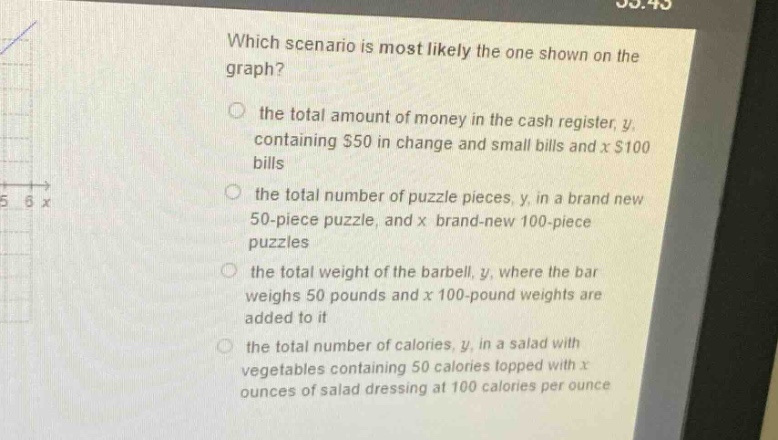
which scenario is most likely the one shown on the graph?\no the total amount of money in the cash register, y, containing $50 in change and small bills and x $100 bills\no the total number of puzzle pieces, y, in a brand - new 50 - piece puzzle, and x brand - new 100 - piece puzzles\no the total weight of the barbell, y, where the bar weighs 50 pounds and x 100 - pound weights are added to it\no the total number of calories, y, in a salad with vegetables containing 50 calories topped with x ounces of salad dressing at 100 calories per ounce
Answer
Explanation:
Step1: Write equations for each scenario
For the money - in - cash - register scenario: The total amount of money $y$ with $50$ in change and small bills and $x$ $100 -$ dollar bills is $y = 100x+50$. For the puzzle - pieces scenario: The total number of puzzle pieces $y$ with a 50 - piece puzzle and $x$ 100 - piece puzzles is $y = 100x + 50$. For the barbell - weight scenario: The total weight of the barbell $y$ with a 50 - pound bar and $x$ 100 - pound weights is $y=100x + 50$. For the calorie - in - salad scenario: The total number of calories $y$ with 50 calories from vegetables and $x$ ounces of 100 - calorie - per - ounce salad dressing is $y=100x + 50$.
Step2: Analyze the nature of the variables
In the money scenario, $x$ (number of $100$ - dollar bills) and $y$ (total money) are non - negative real numbers, but money is usually considered in discrete amounts in practice. In the puzzle - pieces scenario, $x$ (number of 100 - piece puzzles) and $y$ (total number of puzzle pieces) are non - negative integers. In the barbell - weight scenario, $x$ (number of 100 - pound weights) and $y$ (total weight) are non - negative real numbers. In the calorie scenario, $x$ (ounces of salad dressing) and $y$ (total calories) are non - negative real numbers. Since calories can be measured in non - integer values (e.g., you can have a fraction of an ounce of dressing), and assuming the graph allows for non - integer values of the variables, the most likely scenario is the calorie scenario as it is the most common situation where non - integer values for the independent variable ($x$) and dependent variable ($y$) make sense in a real - world context.
Answer:
the total number of calories, $y$, in a salad with vegetables containing 50 calories topped with $x$ ounces of salad dressing at 100 calories per ounce