section: identifying minerals color 1. what other factor besides air and water can change the color of a…
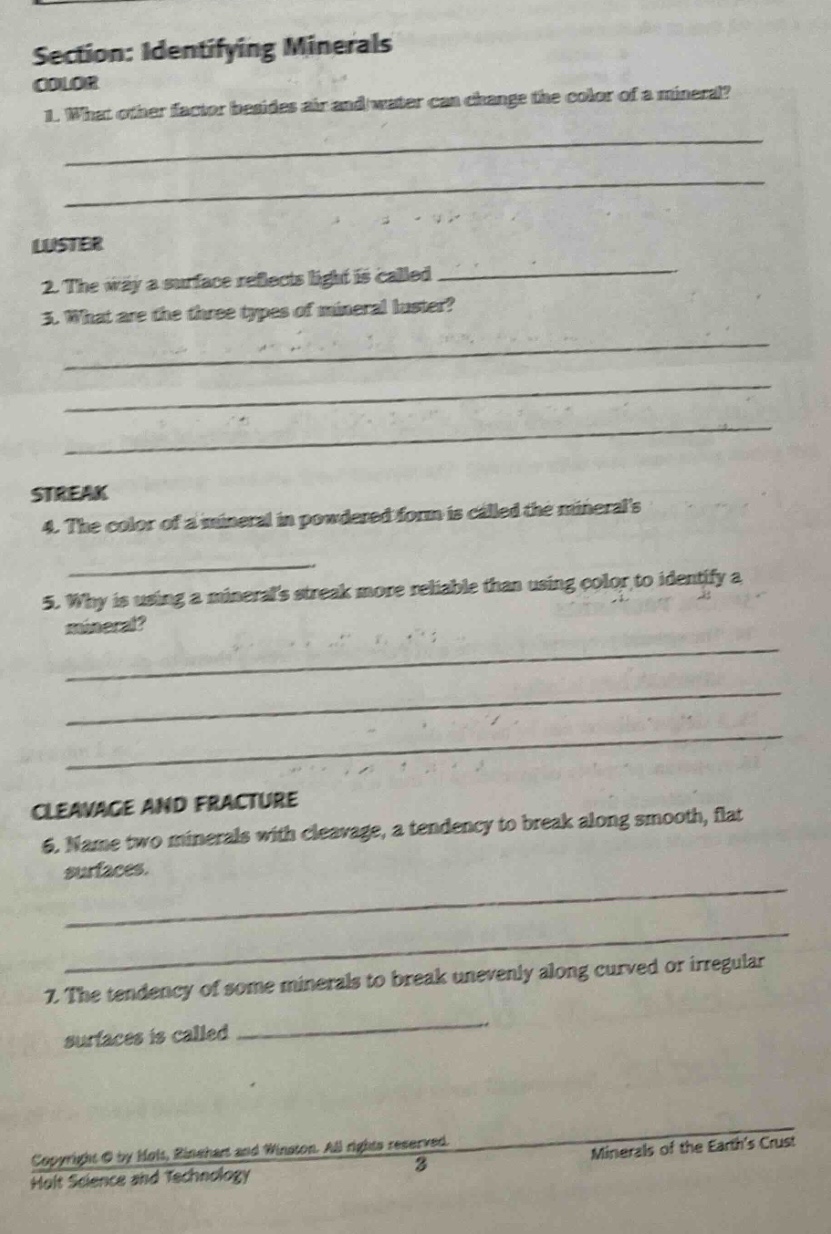
section: identifying minerals color 1. what other factor besides air and water can change the color of a mineral? luster 2. the way a surface reflects light is called 3. what are the three types of mineral luster? streak 4. the color of a mineral in powdered form is called the minerals 5. why is using a minerals streak more reliable than using color to identify a mineral? cleavage and fracture 6. name two minerals with cleavage, a tendency to break along smooth, flat surfaces. 7. the tendency of some minerals to break unevenly along curved or irregular surfaces is called copyright © by holt, rinehart and winston. all rights reserved. minerals of the earths crust 3 holt science and technology
Answer
Brief Explanations:
- Impurities in a mineral can change its color. Different elements or compounds mixed in can cause color - variations.
- The way a surface reflects light is called luster.
- The three types of mineral luster are metallic, non - metallic, and sub - metallic. Metallic luster is shiny like a metal, non - metallic can be glassy, pearly, etc., and sub - metallic is in between.
- The color of a mineral in powdered form is called the mineral's streak.
- Using a mineral's streak is more reliable than using color to identify a mineral because a mineral's color can vary due to impurities, but its streak color is more consistent as it represents the true color of the mineral's powder.
- Two minerals with cleavage are mica and halite. Mica has excellent one - direction cleavage and halite has cubic cleavage.
- The tendency of some minerals to break unevenly along curved or irregular surfaces is called fracture.
Answer:
- Impurities
- Luster
- Metallic, non - metallic, sub - metallic
- Streak
- A mineral's color can vary due to impurities, but streak color is more consistent.
- Mica, halite
- Fracture