select the correct answer. circle c has a center at (-2,10) and contains the point p(10,5). which equation…
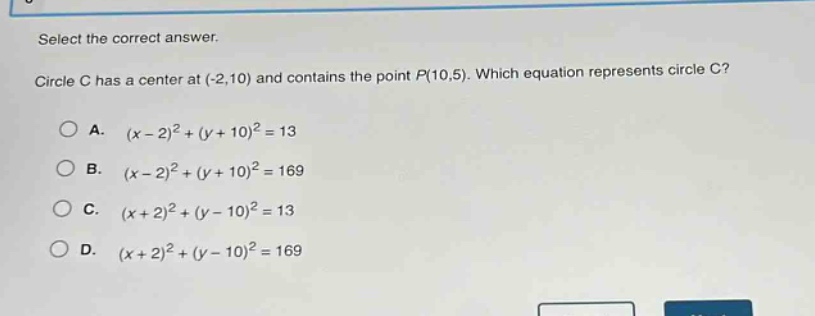
select the correct answer. circle c has a center at (-2,10) and contains the point p(10,5). which equation represents circle c? a. (x - 2)^2+(y + 10)^2 = 13 b. (x - 2)^2+(y + 10)^2 = 169 c. (x + 2)^2+(y - 10)^2 = 13 d. (x + 2)^2+(y - 10)^2 = 169
Answer
Explanation:
Step1: Recall the standard - form of a circle equation
The standard - form of a circle equation is $(x - h)^2+(y - k)^2=r^2$, where $(h,k)$ is the center of the circle and $r$ is the radius. Given the center of circle $C$ is $(-2,10)$, so $h=-2$ and $k = 10$. The equation of the circle starts as $(x+2)^2+(y - 10)^2=r^2$.
Step2: Calculate the radius
The radius $r$ is the distance between the center $(-2,10)$ and the point $P(10,5)$ on the circle. Use the distance formula $d=\sqrt{(x_2 - x_1)^2+(y_2 - y_1)^2}$. Here, $x_1=-2,y_1 = 10,x_2=10,y_2 = 5$. Then $r=\sqrt{(10+2)^2+(5 - 10)^2}=\sqrt{12^2+( - 5)^2}=\sqrt{144 + 25}=\sqrt{169}=13$. So $r^2 = 169$.
Step3: Write the equation of the circle
Substitute $r^2 = 169$ into the equation $(x+2)^2+(y - 10)^2=r^2$. The equation of circle $C$ is $(x + 2)^2+(y - 10)^2=169$.
Answer:
D. $(x + 2)^2+(y - 10)^2=169$