select the correct answer.\nwhich function defines $(f \\div g)(x)$?\n$f(x) = (3.6)^{x+2}$\n$g(x) =…
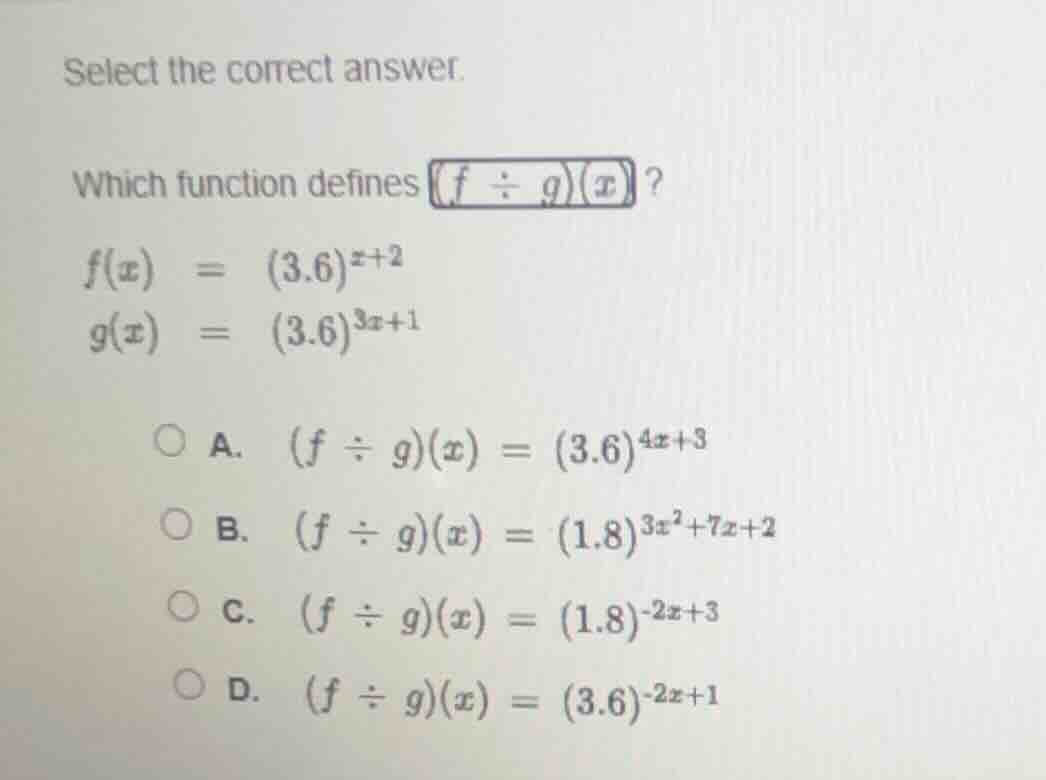
select the correct answer.\nwhich function defines $(f \\div g)(x)$?\n$f(x) = (3.6)^{x+2}$\n$g(x) = (3.6)^{3x+1}$\na. $(f \\div g)(x) = (3.6)^{4x+3}$\nb. $(f \\div g)(x) = (1.8)^{3x^2+7x+2}$\nc. $(f \\div g)(x) = (1.8)^{-2x+3}$\nd. $(f \\div g)(x) = (3.6)^{-2x+1}$
Answer
Explanation:
Step1: Define the quotient function
$(f \div g)(x) = \frac{f(x)}{g(x)}$
Step2: Substitute given functions
$\frac{(3.6)^{x+2}}{(3.6)^{3x+1}}$
Step3: Apply exponent division rule
For $a^m \div a^n = a^{m-n}$, so: $(3.6)^{(x+2)-(3x+1)}$
Step4: Simplify the exponent
$(3.6)^{x+2-3x-1} = (3.6)^{-2x+1}$
Answer:
D. $(f \div g)(x) = (3.6)^{-2x+1}$