select the correct answer. which function represents a function with zeros at -3, -1, 0, and 6? a. $y=(x…
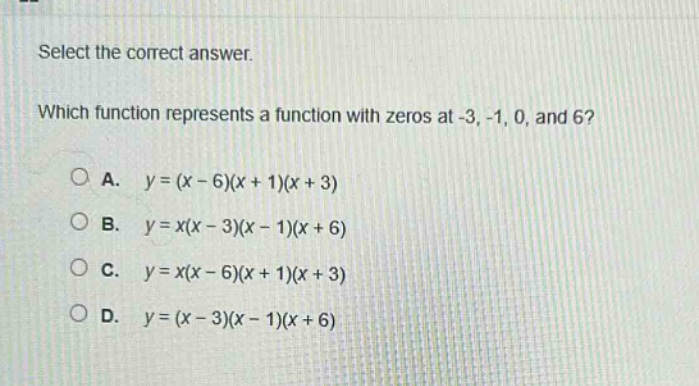
select the correct answer. which function represents a function with zeros at -3, -1, 0, and 6? a. $y=(x - 6)(x + 1)(x + 3)$ b. $y=x(x - 3)(x - 1)(x + 6)$ c. $y=x(x - 6)(x + 1)(x + 3)$ d. $y=(x - 3)(x - 1)(x + 6)$
Answer
Explanation:
Step1: Recall zero - product property
If (y=(x - a)(x - b)(x - c)(x - d)), then the zeros of the function are (x = a), (x = b), (x = c), (x = d).
Step2: Check each option for given zeros
For option A: (y=(x - 6)(x + 1)(x + 3)), the zeros are (x = 6), (x=-1), (x=-3), missing (x = 0). For option B: (y=x(x - 3)(x - 1)(x + 6)), the zeros are (x = 0), (x = 3), (x = 1), (x=-6), not the given zeros. For option C: (y=x(x - 6)(x + 1)(x + 3)), when (y = 0), (x=0) or (x - 6=0) (so (x = 6)) or (x + 1=0) (so (x=-1)) or (x + 3=0) (so (x=-3)). For option D: (y=(x - 3)(x - 1)(x + 6)), the zeros are (x = 3), (x = 1), (x=-6), not the given zeros.
Answer:
C. (y=x(x - 6)(x + 1)(x + 3))