select the correct answer.\nrational functions v and w both have a point of discontinuity at x = 7. which…
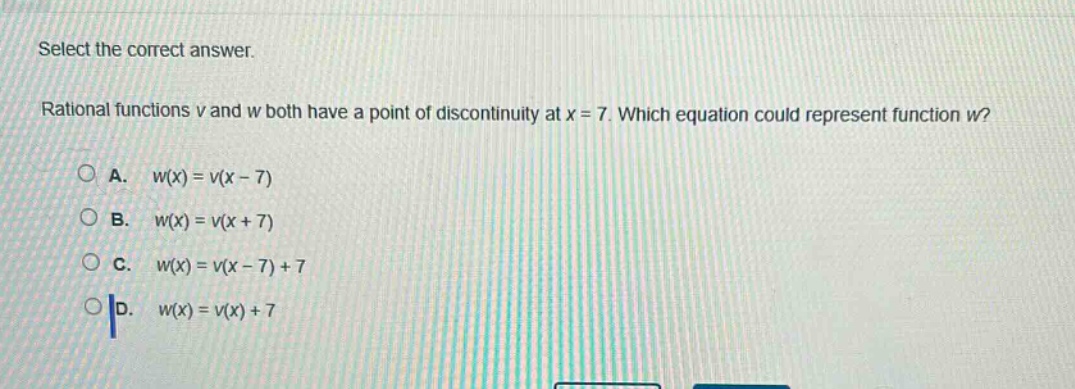
select the correct answer.\nrational functions v and w both have a point of discontinuity at x = 7. which equation could represent function w?\na. w(x)=v(x - 7)\nb. w(x)=v(x + 7)\nc. w(x)=v(x - 7)+7\nd. w(x)=v(x)+7
Answer
Explanation:
Step1: Recall function - transformation rules
A point of discontinuity in a function (y = f(x)) occurs at a certain (x) - value. If (v(x)) has a point of discontinuity at (x = 7), we want to find a transformation of (v(x)) such that (w(x)) also has a point of discontinuity at (x = 7). For a function (y = f(x)), a horizontal shift of (h) units to the right is given by (y=f(x - h)), and a horizontal shift of (h) units to the left is given by (y = f(x+h)), and a vertical shift of (k) units up is given by (y=f(x)+k) and down by (y = f(x)-k).
Step2: Analyze each option
- Option A: If (w(x)=v(x - 7)), the point of discontinuity of (v(x)) which is at (x = 7) for (v(x)) will be at (x-7 = 7), or (x = 14) for (w(x)).
- Option B: If (w(x)=v(x + 7)), let (u=x + 7). When (u = 7) (the point of discontinuity of (v(u))), then (x=0). So the point of discontinuity of (w(x)) is at (x = 0).
- Option C: If (w(x)=v(x - 7)+7), first, considering the inner - function (u=x - 7), when (u = 7) (the point of discontinuity of (v(u))), we have (x-7 = 7), so (x = 14). The vertical shift of 7 units does not affect the (x) - value of the point of discontinuity.
- Option D: If (w(x)=v(x)+7), a vertical shift of 7 units up does not change the (x) - value of the point of discontinuity. Since (v(x)) has a point of discontinuity at (x = 7), (w(x)=v(x)+7) will also have a point of discontinuity at (x = 7).
Answer:
D. (w(x)=v(x)+7)