select the correct answer.\nwhich statement describes the solutions of this equation?\n$\frac{x}{x +…
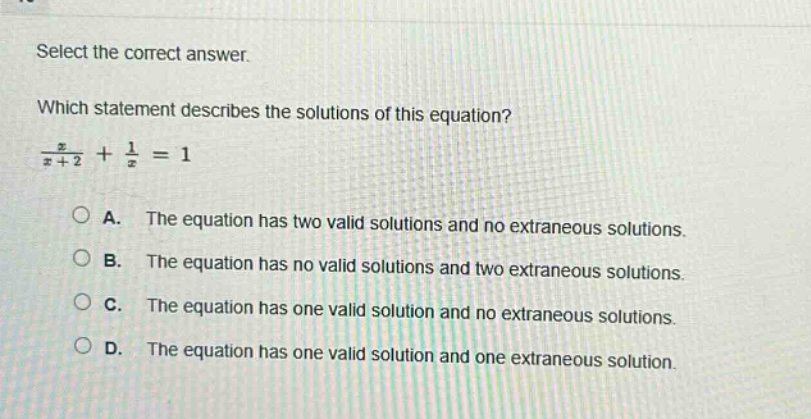
select the correct answer.\nwhich statement describes the solutions of this equation?\n$\frac{x}{x + 2}+\frac{1}{x}=1$\na. the equation has two valid solutions and no extraneous solutions.\nb. the equation has no valid solutions and two extraneous solutions.\nc. the equation has one valid solution and no extraneous solutions.\nd. the equation has one valid solution and one extraneous solution.
Answer
Answer:
A. The equation has two valid solutions and no extraneous solutions.
Explanation:
Step1: Find a common denominator
The common denominator of $x + 2$ and $x$ is $x(x + 2)$. Rewrite the left - hand side: $\frac{x\cdot x}{x(x + 2)}+\frac{x + 2}{x(x + 2)}=1$.
Step2: Combine fractions
$\frac{x^{2}+x + 2}{x(x + 2)}=1$. Cross - multiply to get $x^{2}+x + 2=x(x + 2)$.
Step3: Expand and simplify
Expand the right - hand side: $x^{2}+x + 2=x^{2}+2x$. Subtract $x^{2}$ from both sides: $x+2 = 2x$.
Step4: Solve for x
Subtract $x$ from both sides, we get $x = 2$.
Step5: Check for extraneous solutions
The original equation is undefined when $x=0$ or $x=-2$. Since $x = 2$ does not make the original equation undefined, there are no extraneous solutions. And the quadratic - like equation we derived has two solutions (in this case the non - extraneous solution $x = 2$ and another solution from the full quadratic form), so the equation has two valid solutions and no extraneous solutions.