select the correct answer. which statement is true of this function? $f(x)=(\frac{1}{5})^x - 2$ a. as the…
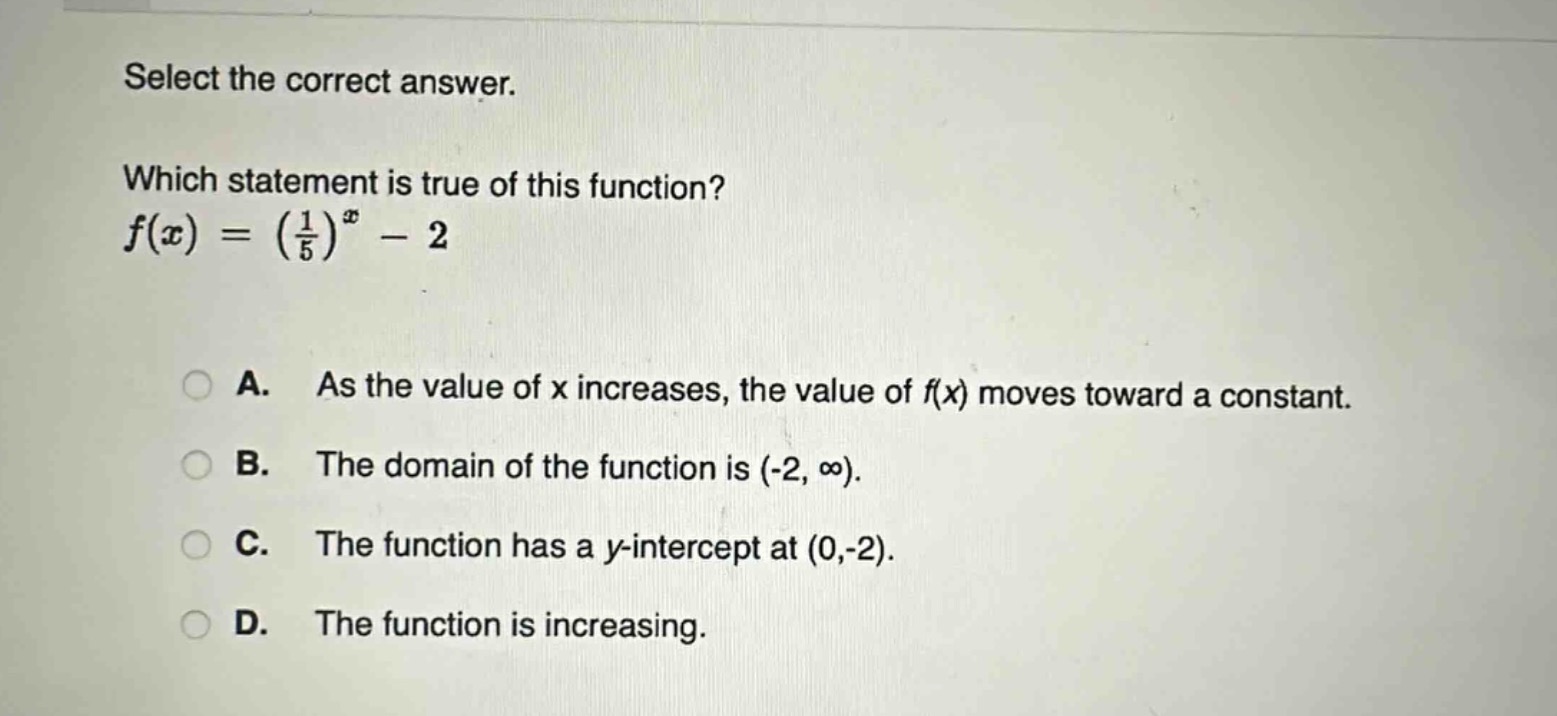
select the correct answer. which statement is true of this function? $f(x)=(\frac{1}{5})^x - 2$ a. as the value of x increases, the value of f(x) moves toward a constant. b. the domain of the function is (-2, ∞). c. the function has a y - intercept at (0,-2). d. the function is increasing.
Answer
Explanation:
Step1: Analyze option A
For the exponential - decay function $y = a^x$ where $0\lt a\lt1$, as $x\to+\infty$, $a^x\to0$. Here $a=\frac{1}{5}$ and $f(x)=(\frac{1}{5})^x - 2$. As $x$ increases, $(\frac{1}{5})^x$ approaches $0$, so $f(x)$ approaches $- 2$.
Step2: Analyze option B
The domain of an exponential function $y = a^x + b$ (where $a\gt0,a\neq1$) is all real numbers, i.e., $(-\infty,\infty)$. For $f(x)=(\frac{1}{5})^x - 2$, the domain is $(-\infty,\infty)$, not $(-2,\infty)$.
Step3: Analyze option C
To find the $y$ - intercept, set $x = 0$. Then $f(0)=(\frac{1}{5})^0-2=1 - 2=-1$, so the $y$ - intercept is $(0, - 1)$, not $(0,-2)$.
Step4: Analyze option D
Since $a=\frac{1}{5}\in(0,1)$, the function $y = (\frac{1}{5})^x$ is a decreasing function. And $f(x)=(\frac{1}{5})^x - 2$ is also a decreasing function.
Answer:
A. As the value of x increases, the value of f(x) moves toward a constant.