select all the correct answers. which equations represent functions? 2x + 3y = 10 4x = 16 2x - 3 = 14 3y =…
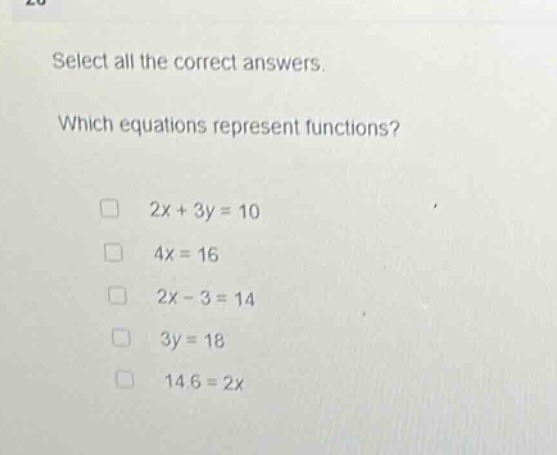
select all the correct answers. which equations represent functions? 2x + 3y = 10 4x = 16 2x - 3 = 14 3y = 18 14.6 = 2x
Answer
Explanation:
Step1: Recall function definition
A function is a relation where for each input (x - value) there is exactly one output (y - value). We can rewrite equations in the form y = f(x).
Step2: Rewrite 2x + 3y = 10
Solve for y: $$3y=10 - 2x$$ $$y=\frac{10 - 2x}{3}=-\frac{2}{3}x+\frac{10}{3}$$. For every x - value, there is a unique y - value. So it is a function.
Step3: Analyze 4x = 16
Solve for x: $x = 4$. This is a vertical line and for the x - value of 4, there are infinitely many y - values. So it is not a function.
Step4: Analyze 2x−3 = 14
Solve for x: $2x=17$, $x=\frac{17}{2}$. This is a vertical line and for the x - value of $\frac{17}{2}$, there are infinitely many y - values. So it is not a function.
Step5: Analyze 3y = 18
Solve for y: $y = 6$. For any x - value, y is always 6. For each x - value in the domain, there is exactly one y - value. So it is a function.
Step6: Analyze 14.6 = 2x
Solve for x: $x = 7.3$. This is a vertical line and for the x - value of 7.3, there are infinitely many y - values. So it is not a function.
Answer:
2x + 3y = 10, 3y = 18