select all of the factors of $x^{3}+5x^{2}+2x - 8$.\n$x + 5$\n$x - 3$\n$x + 4$\n$x - 1$\n$x + 3$\n$x +…
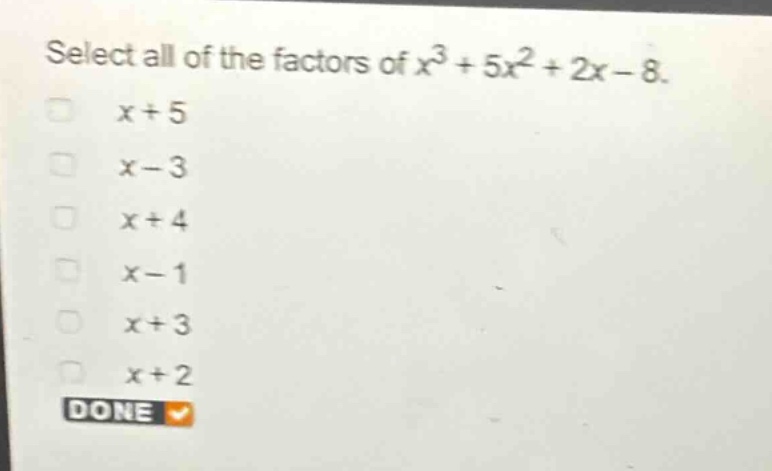
select all of the factors of $x^{3}+5x^{2}+2x - 8$.\n$x + 5$\n$x - 3$\n$x + 4$\n$x - 1$\n$x + 3$\n$x + 2$\ndone
Answer
Explanation:
Step1: Use the factor - theorem
The factor - theorem states that if (f(a)=0), then ((x - a)) is a factor of the polynomial (f(x)=x^{3}+5x^{2}+2x - 8).
Step2: Test (x=-5)
Substitute (x = - 5) into (f(x)): (f(-5)=(-5)^{3}+5\times(-5)^{2}+2\times(-5)-8=-125 + 125-10 - 8=-18\neq0), so (x + 5) is not a factor.
Step3: Test (x = 3)
Substitute (x = 3) into (f(x)): (f(3)=3^{3}+5\times3^{2}+2\times3-8=27+45 + 6-8=70\neq0), so (x - 3) is not a factor.
Step4: Test (x=-4)
Substitute (x=-4) into (f(x)): (f(-4)=(-4)^{3}+5\times(-4)^{2}+2\times(-4)-8=-64 + 80-8 - 8=0), so (x + 4) is a factor.
Step5: Test (x = 1)
Substitute (x = 1) into (f(x)): (f(1)=1^{3}+5\times1^{2}+2\times1-8=1 + 5+2 - 8=0), so (x - 1) is a factor.
Step6: Test (x=-3)
Substitute (x=-3) into (f(x)): (f(-3)=(-3)^{3}+5\times(-3)^{2}+2\times(-3)-8=-27 + 45-6 - 8=4\neq0), so (x + 3) is not a factor.
Step7: Test (x=-2)
Substitute (x=-2) into (f(x)): (f(-2)=(-2)^{3}+5\times(-2)^{2}+2\times(-2)-8=-8 + 20-4 - 8=0), so (x + 2) is a factor.
Answer:
C. (x + 4), D. (x - 1), F. (x + 2)