select all of the following tables which represent $y$ as a function of $x$ and are one-to-one.\n$\\begin{arr…
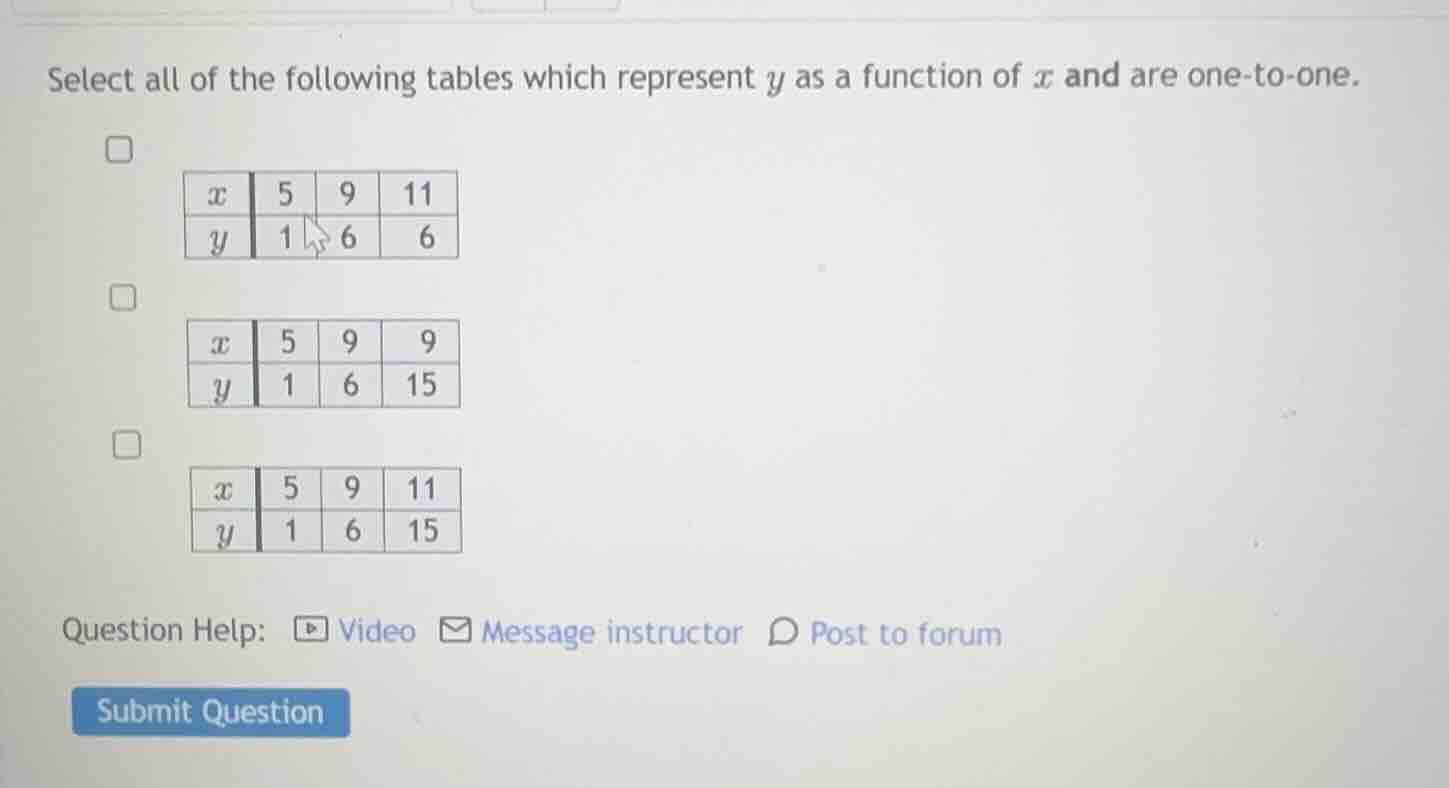
select all of the following tables which represent $y$ as a function of $x$ and are one-to-one.\n$\\begin{array}{|c|c|c|c|}\\hline x & 5 & 9 & 11 \\\\ \\hline y & 1 & 6 & 6 \\\\ \\hline\\end{array}$\n$\\begin{array}{|c|c|c|c|}\\hline x & 5 & 9 & 9 \\\\ \\hline y & 1 & 6 & 15 \\\\ \\hline\\end{array}$\n$\\begin{array}{|c|c|c|c|}\\hline x & 5 & 9 & 11 \\\\ \\hline y & 1 & 6 & 15 \\\\ \\hline\\end{array}$\nquestion help: video message instructor post to forum\nsubmit question
Answer
Explanation:
Step1: Check function rule (unique x-values)
A function requires each $x$ to map to only one $y$.
- Table1: $x$-values {5,9,11} (all unique) → is a function.
- Table2: $x$-values {5,9,9} (duplicate 9) → not a function.
- Table3: $x$-values {5,9,11} (all unique) → is a function.
Step2: Check one-to-one rule (unique y-values)
A one-to-one function requires each $y$ to map to only one $x$.
- Table1: $y$-values {1,6,6} (duplicate 6) → not one-to-one.
- Table3: $y$-values {1,6,15} (all unique) → is one-to-one.
Answer:
The table with $x$: 5, 9, 11 and $y$: 1, 6, 15 (the third table)