a sequence is defined by the recursive formula (f(n + 1)=1.5f(n)). which sequence could be generated using…
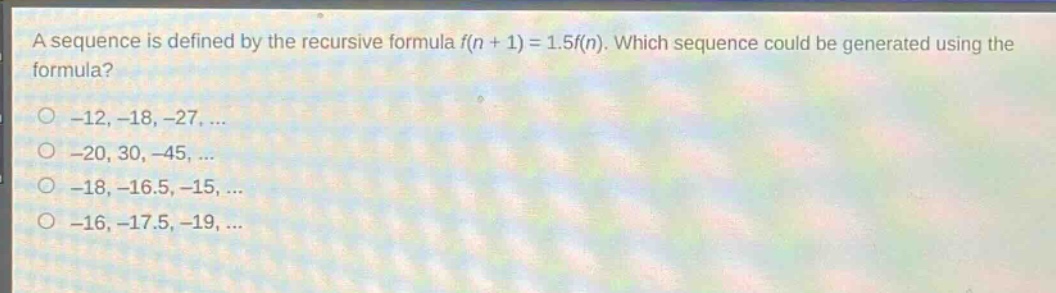
a sequence is defined by the recursive formula (f(n + 1)=1.5f(n)). which sequence could be generated using the formula?\n-12, -18, -27, ...\n-20, 30, -45, ...\n-18, -16.5, -15, ...\n-16, -17.5, -19, ...
Answer
Explanation:
Step1: Identify the common - ratio property
The recursive formula $f(n + 1)=1.5f(n)$ indicates a geometric sequence with a common ratio $r = 1.5$. To check which sequence is generated, divide each term by the previous term.
Step2: Check the first sequence
For the sequence $- 12,-18,-27,\cdots$, calculate the ratio of the second term to the first term: $\frac{-18}{-12}=1.5$, and the ratio of the third term to the second term: $\frac{-27}{-18}=1.5$.
Step3: Check the second sequence
For the sequence $-20,30,-45,\cdots$, the ratio of the second term to the first term is $\frac{30}{-20}=-1.5$.
Step4: Check the third sequence
For the sequence $-18,-16.5,-15,\cdots$, the ratio of the second term to the first term is $\frac{-16.5}{-18}=\frac{11}{12}\neq1.5$.
Step5: Check the fourth sequence
For the sequence $-16,-17.5,-19,\cdots$, the ratio of the second term to the first term is $\frac{-17.5}{-16}=\frac{35}{32}\neq1.5$.
Answer:
$-12,-18,-27,\cdots$