the sequence of figures shows a pattern. if the pattern repeats, how many small squares will figure 4 have…
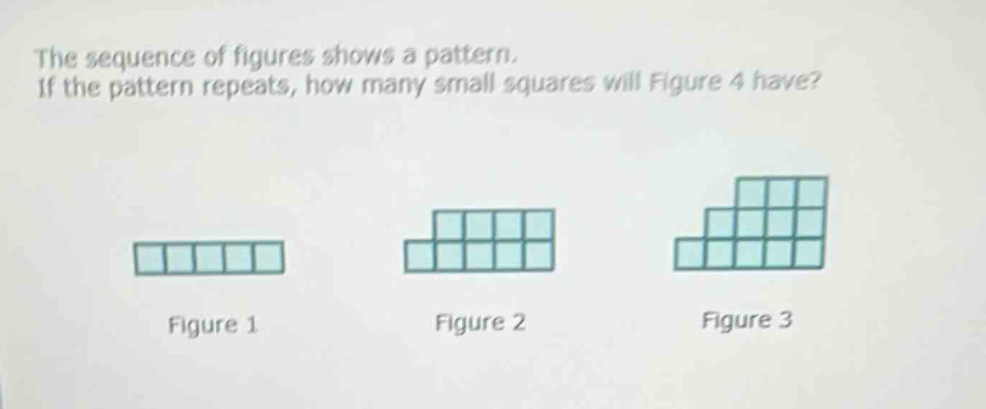
the sequence of figures shows a pattern. if the pattern repeats, how many small squares will figure 4 have? figure 1 figure 2 figure 3
Answer
Explanation:
Step1: Analyze the number of squares in each figure
Figure 1 has 5 squares. Figure 2 has 8 squares (5 + 3). Figure 3 has 11 squares (8+ 3).
Step2: Identify the pattern
The number of squares in each figure forms an arithmetic - sequence with a first term (a_1 = 5) and a common difference (d = 3). The formula for the (n)th term of an arithmetic sequence is (a_n=a_1+(n - 1)d).
Step3: Calculate the number of squares in Figure 4
Substitute (n = 4), (a_1=5), and (d = 3) into the formula (a_n=a_1+(n - 1)d). So (a_4=5+(4 - 1)\times3=5 + 9=14).
Answer:
14