which sequence can be generated from the formula $f(x + 1)=\frac{1}{2}(f(x))$?\n$x,\frac{x}{2},\frac{x}{4},\f…
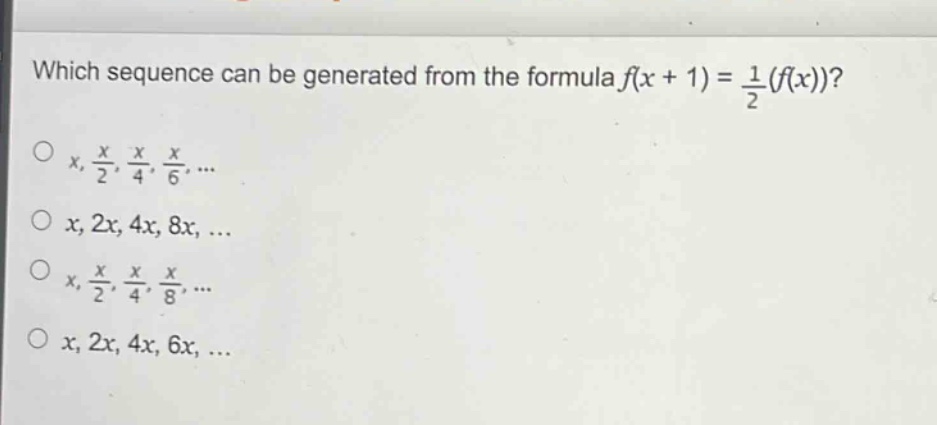
which sequence can be generated from the formula $f(x + 1)=\frac{1}{2}(f(x))$?\n$x,\frac{x}{2},\frac{x}{4},\frac{x}{6},cdots$\n$x,2x,4x,8x,cdots$\n$x,\frac{x}{2},\frac{x}{4},\frac{x}{8},cdots$\n$x,2x,4x,6x,cdots$
Answer
Explanation:
Step1: Analyze the formula
The formula $f(x + 1)=\frac{1}{2}(f(x))$ means each term is half of the previous term.
Step2: Check each option
For the first option, the denominators of the fractions are not powers of 2 as required. For the second option, each term is double the previous term, not half. For the third option, if $f(1)=x$, then $f(2)=\frac{1}{2}f(1)=\frac{x}{2}$, $f(3)=\frac{1}{2}f(2)=\frac{x}{4}$, $f(4)=\frac{1}{2}f(3)=\frac{x}{8}$, which follows the formula. For the fourth option, the common - difference is $2x$, not a common ratio of $\frac{1}{2}$.
Answer:
$x,\frac{x}{2},\frac{x}{4},\frac{x}{8},\cdots$