which set of ordered pairs could be generated by an exponential function?\n(0, 0), (1, 1), (2, 8), (3…
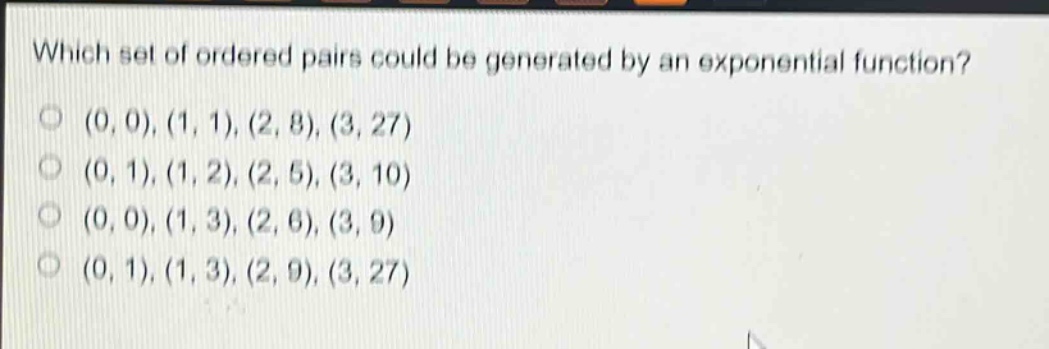
which set of ordered pairs could be generated by an exponential function?\n(0, 0), (1, 1), (2, 8), (3, 27)\n(0, 1), (1, 2), (2, 5), (3, 10)\n(0, 0), (1, 3), (2, 6), (3, 9)\n(0, 1), (1, 3), (2, 9), (3, 27)
Answer
Explanation:
Step1: Recall exponential - function form
The general form of an exponential function is $y = ab^{x}$, where $a\neq0$, $b>0$ and $b\neq1$. When $x = 0$, $y=ab^{0}=a$. So, for an exponential function, when $x = 0$, $y=a\neq0$ (except in some degenerate cases which are not the standard form). We can eliminate the options with $(0,0)$.
Step2: Check the ratio of $y$ - values
For an exponential function $y = ab^{x}$, if we have two points $(x_1,y_1)$ and $(x_2,y_2)$, then $\frac{y_2}{y_1}=\frac{ab^{x_2}}{ab^{x_1}}=b^{x_2 - x_1}$. For the set of points $(0,1),(1,3),(2,9),(3,27)$: When $x_1 = 0,y_1 = 1$ and $x_2 = 1,y_2 = 3$, $\frac{y_2}{y_1}=\frac{3}{1}=3$. When $x_1 = 1,y_1 = 3$ and $x_2 = 2,y_2 = 9$, $\frac{y_2}{y_1}=\frac{9}{3}=3$. When $x_1 = 2,y_1 = 9$ and $x_2 = 3,y_2 = 27$, $\frac{y_2}{y_1}=\frac{27}{9}=3$. The ratio of consecutive $y$ - values is constant, which is a characteristic of an exponential function.
Answer:
$(0,1),(1,3),(2,9),(3,27)$