which set of ordered pairs could be generated by an exponential function?\n(1,1), (2,\\frac{1}{2})…
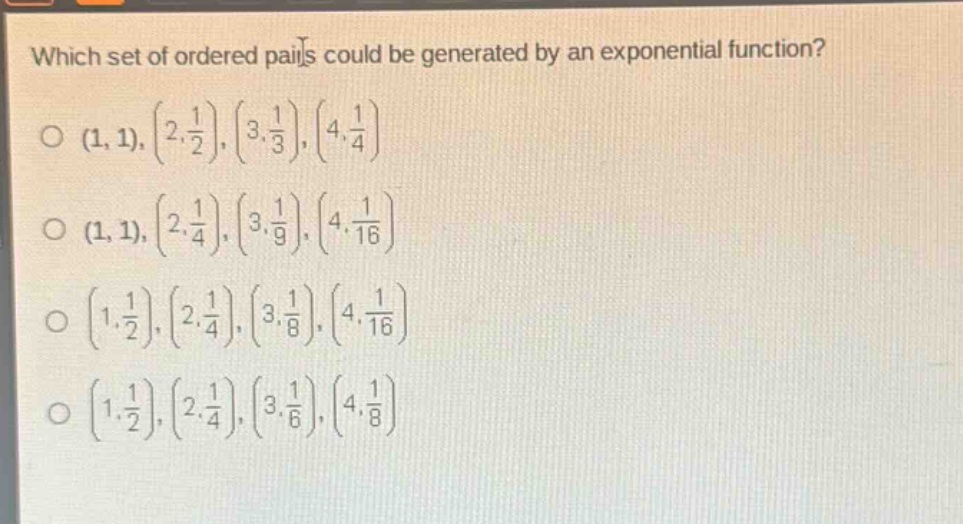
which set of ordered pairs could be generated by an exponential function?\n(1,1), (2,\\frac{1}{2}), (3,\\frac{1}{3}), (4,\\frac{1}{4})\n(1,1), (2,\\frac{1}{4}), (3,\\frac{1}{9}), (4,\\frac{1}{16})\n(1,\\frac{1}{2}), (2,\\frac{1}{4}), (3,\\frac{1}{8}), (4,\\frac{1}{16})\n(1,\\frac{1}{2}), (2,\\frac{1}{4}), (3,\\frac{1}{6}), (4,\\frac{1}{8})
Answer
Explanation:
Step1: Recall exponential - function form
The general form of an exponential function is (y = a\cdot b^{x}), where (a\neq0), (b> 0) and (b\neq1). When (x = 1), (y=a\cdot b); when (x = 2), (y=a\cdot b^{2}); when (x = 3), (y=a\cdot b^{3}); when (x = 4), (y=a\cdot b^{4}). The ratio of consecutive (y) - values for consecutive integer (x) - values ((x=n) and (x=n + 1)) is (\frac{a\cdot b^{n + 1}}{a\cdot b^{n}}=b) (a constant).
Step2: Check option 1
For the set ((1,1),(2,\frac{1}{2}),(3,\frac{1}{3}),(4,\frac{1}{4})), the ratios of consecutive (y) - values are (\frac{\frac{1}{2}}{1}=\frac{1}{2}), (\frac{\frac{1}{3}}{\frac{1}{2}}=\frac{2}{3}), (\frac{\frac{1}{4}}{\frac{1}{3}}=\frac{3}{4}). Since the ratios are not constant, this set is not generated by an exponential function.
Step3: Check option 2
For the set ((1,1),(2,\frac{1}{4}),(3,\frac{1}{9}),(4,\frac{1}{16})), the ratios of consecutive (y) - values are (\frac{\frac{1}{4}}{1}=\frac{1}{4}), (\frac{\frac{1}{9}}{\frac{1}{4}}=\frac{4}{9}), (\frac{\frac{1}{16}}{\frac{1}{9}}=\frac{9}{16}). Since the ratios are not constant, this set is not generated by an exponential function.
Step4: Check option 3
For the set ((1,\frac{1}{2}),(2,\frac{1}{4}),(3,\frac{1}{8}),(4,\frac{1}{16})), the ratios of consecutive (y) - values are (\frac{\frac{1}{4}}{\frac{1}{2}}=\frac{1}{2}), (\frac{\frac{1}{8}}{\frac{1}{4}}=\frac{1}{2}), (\frac{\frac{1}{16}}{\frac{1}{8}}=\frac{1}{2}). Since the ratio of consecutive (y) - values for consecutive integer (x) - values is constant ((b=\frac{1}{2})), this set could be generated by an exponential function of the form (y=\frac{1}{2}\cdot(\frac{1}{2})^{x - 1}=(\frac{1}{2})^{x}).
Step5: Check option 4
For the set ((1,\frac{1}{2}),(2,\frac{1}{4}),(3,\frac{1}{6}),(4,\frac{1}{8})), the ratios of consecutive (y) - values are (\frac{\frac{1}{4}}{\frac{1}{2}}=\frac{1}{2}), (\frac{\frac{1}{6}}{\frac{1}{4}}=\frac{2}{3}), (\frac{\frac{1}{8}}{\frac{1}{6}}=\frac{3}{4}). Since the ratios are not constant, this set is not generated by an exponential function.
Answer:
((1,\frac{1}{2}),(2,\frac{1}{4}),(3,\frac{1}{8}),(4,\frac{1}{16}))