which set of ordered pairs could be generated by an exponential function?\n$\\left(-1,-\\frac{1}{2}\\right),(…
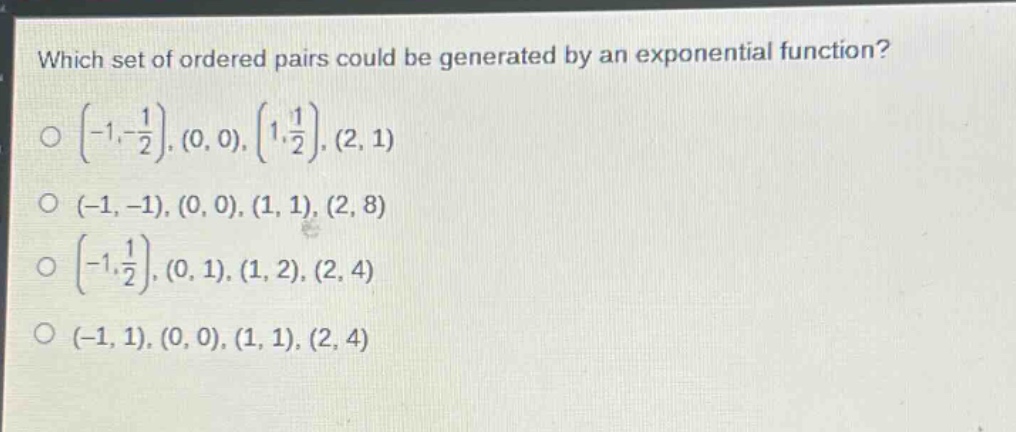
which set of ordered pairs could be generated by an exponential function?\n$\\left(-1,-\\frac{1}{2}\\right),(0,0),\\left(1,\\frac{1}{2}\\right),(2,1)$\n$(-1, -1),(0,0),(1,1),(2,8)$\n$\\left(-1,\\frac{1}{2}\\right),(0,1),(1,2),(2,4)$\n$(-1,1),(0,0),(1,1),(2,4)$
Answer
Explanation:
Step1: Recall exponential - function form
The general form of an exponential function is $y = ab^{x}$, where $a\neq0$, $b>0$ and $b\neq1$. When $x = 0$, $y=a\times b^{0}=a$. So, for an exponential function, when $x = 0$, $y\neq0$.
Step2: Check each option
- Option 1: The set $\left{(-1,-\frac{1}{2}),(0,0),(1,\frac{1}{2}),(2,1)\right}$ has $(0,0)$. Since for $y = ab^{x}$, when $x = 0$, $y=a\neq0$, this set cannot be generated by an exponential function.
- Option 2: The set ${(-1, - 1),(0,0),(1,1),(2,8)}$ has $(0,0)$. Since for $y = ab^{x}$, when $x = 0$, $y=a\neq0$, this set cannot be generated by an exponential function.
- Option 3: The set $\left{(-1,\frac{1}{2}),(0,1),(1,2),(2,4)\right}$. When $x = 0$, $y = 1$, so $a = 1$. The function is of the form $y=b^{x}$. When $x=-1$, $y=\frac{1}{2}$, then $\frac{1}{2}=b^{-1}=\frac{1}{b}$, so $b = 2$. The function is $y = 2^{x}$, and when $x = 1$, $y=2^{1}=2$; when $x = 2$, $y=2^{2}=4$. This set can be generated by the exponential function $y = 2^{x}$.
- Option 4: The set ${(-1,1),(0,0),(1,1),(2,4)}$ has $(0,0)$. Since for $y = ab^{x}$, when $x = 0$, $y=a\neq0$, this set cannot be generated by an exponential function.
Answer:
$\left{(-1,\frac{1}{2}),(0,1),(1,2),(2,4)\right}$