which set of steps will translate (f(x)=6^{x}) to (g(x)=6^{x - 5}-7)?\nshift (f(x)=6^{x}) five units to the…
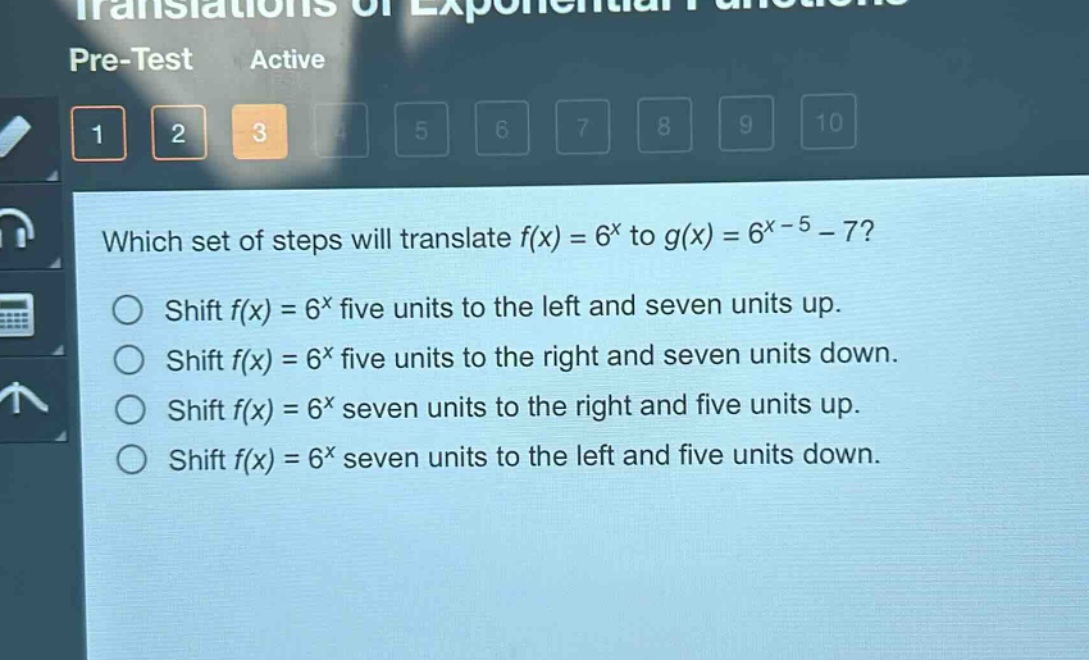
which set of steps will translate (f(x)=6^{x}) to (g(x)=6^{x - 5}-7)?\nshift (f(x)=6^{x}) five units to the left and seven units up.\nshift (f(x)=6^{x}) five units to the right and seven units down.\nshift (f(x)=6^{x}) seven units to the right and five units up.\nshift (f(x)=6^{x}) seven units to the left and five units down.
Answer
Explanation:
Step1: Recall horizontal - shift rule
For a function $y = f(x - h)$, the graph of $y = f(x)$ is shifted $h$ units to the right. In $g(x)=6^{x - 5}$, comparing with $f(x)=6^{x}$, we have $h = 5$. So, the graph of $f(x)=6^{x}$ is shifted 5 units to the right.
Step2: Recall vertical - shift rule
For a function $y=f(x)-k$, the graph of $y = f(x)$ is shifted $k$ units down. In $g(x)=6^{x - 5}-7$, comparing with $y = 6^{x - 5}$, we have $k = 7$. So, the graph of $y = 6^{x - 5}$ is shifted 7 units down.
Answer:
Shift $f(x)=6^{x}$ five units to the right and seven units down.