which set of transformations is needed to graph (f(x)= - 2sin(x)+3) from the parent sine function?\nvertical…
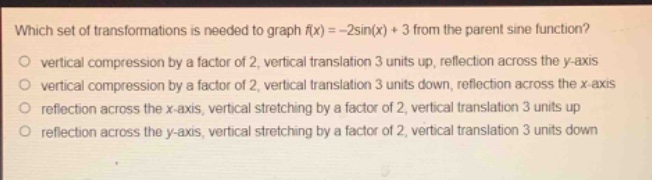
which set of transformations is needed to graph (f(x)= - 2sin(x)+3) from the parent sine function?\nvertical compression by a factor of 2, vertical translation 3 units up, reflection across the y - axis\nvertical compression by a factor of 2, vertical translation 3 units down, reflection across the x - axis\nreflection across the x - axis, vertical stretching by a factor of 2, vertical translation 3 units up\nreflection across the y - axis, vertical stretching by a factor of 2, vertical translation 3 units down
Answer
Answer:
C. reflection across the x - axis, vertical stretching by a factor of 2, vertical translation 3 units up
Explanation:
Step1: Analyze the coefficient of $\sin(x)$
The parent sine function is $y = \sin(x)$. The function $f(x)=- 2\sin(x)+3$ has a coefficient of -2 in front of $\sin(x)$. The negative sign reflects the graph of $y = \sin(x)$ across the x - axis.
Step2: Analyze the magnitude of the coefficient
The magnitude of the coefficient 2 of $\sin(x)$ causes a vertical stretching of the graph of $y=\sin(x)$ by a factor of 2.
Step3: Analyze the constant term
The + 3 at the end of the function $f(x)=-2\sin(x)+3$ causes a vertical translation of 3 units up.