several ordered pairs from a continuous exponential function are shown in the table.\n| x | y…
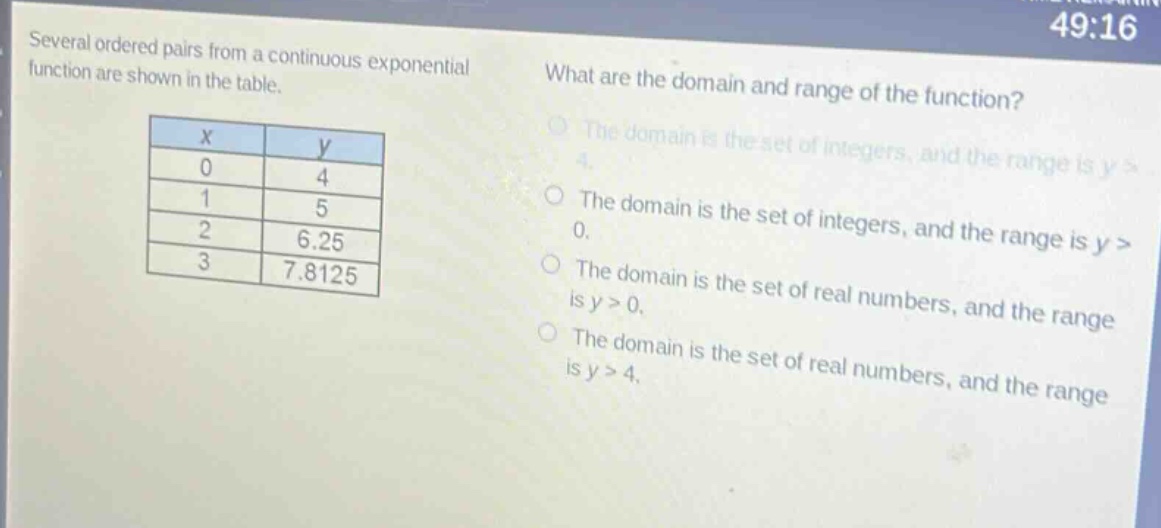
several ordered pairs from a continuous exponential function are shown in the table.\n| x | y |\n|----|----|\n| 0 | 4 |\n| 1 | 5 |\n| 2 | 6.25 |\n| 3 | 7.8125 |\nwhat are the domain and range of the function?\nthe domain is the set of integers, and the range is y > 4.\nthe domain is the set of integers, and the range is y > 0.\nthe domain is the set of real numbers, and the range is y > 0.\nthe domain is the set of real numbers, and the range is y > 4.
Answer
Explanation:
Step1: Recall domain - range of exponential functions
For a continuous exponential function (y = ab^{x}+k) (in general form), the domain is the set of all real numbers because we can substitute any real - valued (x) into the function.
Step2: Analyze the range
The general form of an exponential function (y = ab^{x}+k) has a horizontal asymptote at (y = k). When (a>0), the function values are above the horizontal asymptote. For an exponential function without vertical shift ((k = 0)) and (a>0), the range is (y>0). In the given table, we have an exponential function, and since it is continuous, the domain is the set of all real numbers and the range is (y > 0) as exponential functions of the form (y=ab^{x}) ((a>0,b > 0,b\neq1)) have a horizontal asymptote at (y = 0) and the function values are always positive.
Answer:
The domain is the set of real numbers, and the range is (y>0).