several ordered pairs from a continuous exponential function are shown in the table.\n| x | y |\n| 0 | 4…
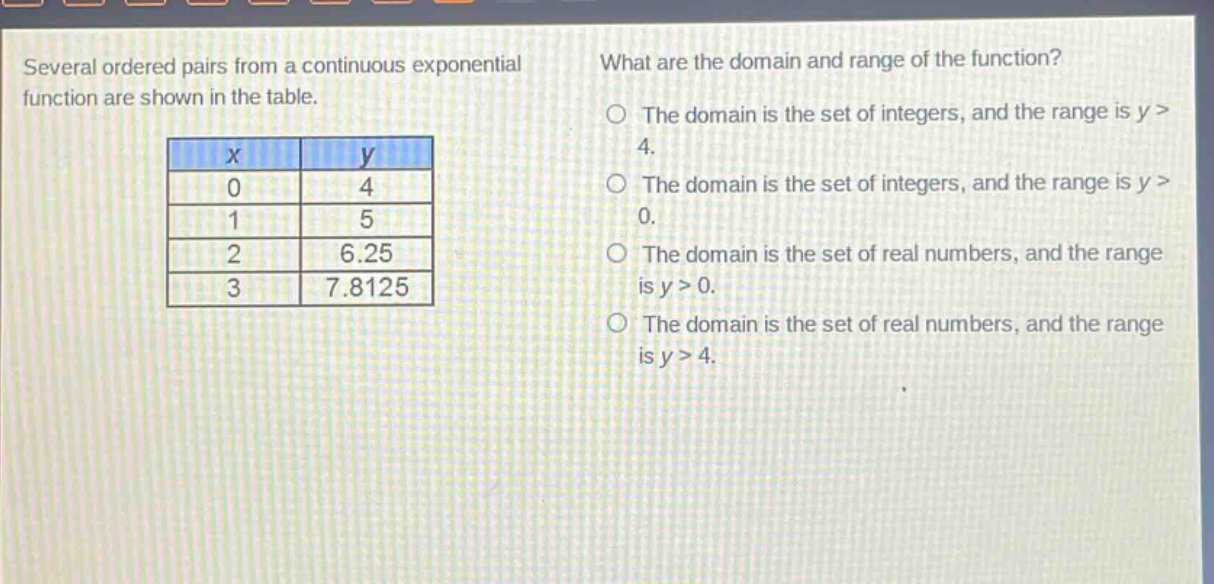
several ordered pairs from a continuous exponential function are shown in the table.\n| x | y |\n| 0 | 4 |\n| 1 | 5 |\n| 2 | 6.25 |\n| 3 | 7.8125 |\nwhat are the domain and range of the function?\nthe domain is the set of integers, and the range is y > 4.\nthe domain is the set of integers, and the range is y > 0.\nthe domain is the set of real numbers, and the range is y > 0.\nthe domain is the set of real numbers, and the range is y > 4.
Answer
Explanation:
Step1: Recall domain definition
The domain of a continuous exponential function is all real - numbers as there are no restrictions on the input variable (x) for the general form (y = a\cdot b^{x}+k).
Step2: Analyze the range
For an exponential function of the form (y = a\cdot b^{x}+k) ((b> 0,b\neq1)), when (a>0), the function (y = a\cdot b^{x}) has a range of (y>0). If we consider a general transformation (y = a\cdot b^{x}+k), the range is (y > k). In this case, we can assume a general exponential form (y=a\cdot b^{x}+k). When (x = 0), (y=a + k=4). As (x) increases, (y) increases. The exponential part (a\cdot b^{x}>0) for all real (x) when (a>0,b > 0,b\neq1), so the range of the function is (y>0).
Answer:
The domain is the set of real numbers, and the range is (y > 0).