shilpas gym membership includes a one - time fee of $20. she then pays a discounted fee of $5 for each…
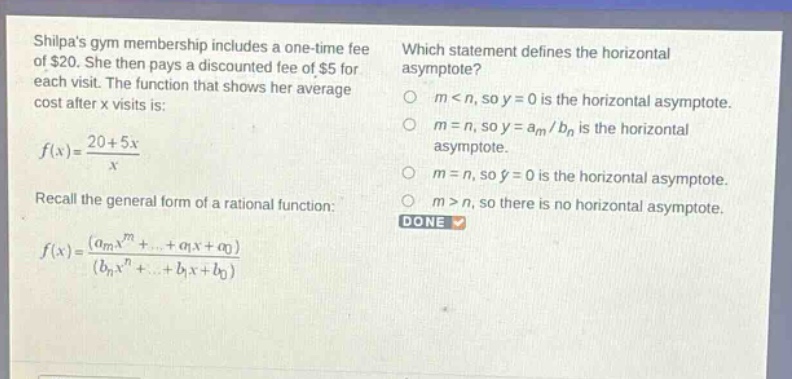
shilpas gym membership includes a one - time fee of $20. she then pays a discounted fee of $5 for each visit. the function that shows her average cost after x visits is: $f(x)=\frac{20 + 5x}{x}$. recall the general form of a rational function: $f(x)=\frac{(a_mx^m+cdots+a_1x + a_0)}{(b_nx^n+cdots+b_1x + b_0)}$. which statement defines the horizontal asymptote? $m < n$, so $y = 0$ is the horizontal asymptote. $m = n$, so $y=a_m/b_n$ is the horizontal asymptote. $m = n$, so $y = 0$ is the horizontal asymptote. $m>n$, so there is no horizontal asymptote. done
Answer
Explanation:
Step1: Identify the degrees of numerator and denominator
For $f(x)=\frac{20 + 5x}{x}$, the numerator $20+5x$ has degree $m = 1$ (highest - power of $x$ is 1), and the denominator $x$ has degree $n = 1$.
Step2: Recall the rule for horizontal asymptotes of rational functions
When $m=n$ in a rational function $f(x)=\frac{a_mx^m+\cdots+a_0}{b_nx^n+\cdots + b_0}$, the horizontal asymptote is $y=\frac{a_m}{b_n}$. Here, $a_m = 5$ and $b_n=1$, so $y=\frac{5}{1}=5$. But looking at the options in terms of the general rule statement, when $m = n$, the horizontal asymptote is $y=\frac{a_m}{b_n}$.
Answer:
$m = n$, so $y=a_m/b_n$ is the horizontal asymptote.